
- May 6, 2026
- Posted by: Josh Knoll
- Category: Gynecology

A routine annual well-woman health test should be one of the most straightforward claims a gynecology practice submits. It is a defined visit type, covered under most commercial plans and Medicare, and performed hundreds of times a year in most OB-GYN offices; yet, denial rates for preventive gynecology visits remain stubbornly high.
Not to forget, the downstream effect adds up fast. Rework on a single denied preventive claim can consume 20 to 45 minutes of staff time. Multiply that across a busy practice and a manageable gynecology billing function quietly becomes a significant operational drag. Delayed payments stretch A/R days. Providers begin questioning whether payers are acting in bad faith, when the more uncomfortable truth is that a large share of these denials comes from internal process gaps in gynecology billing services and not from payer aggression alone.
So, here are some stats to take note of:
- 23% average denial rate for preventive visits in OB-GYN practices without dedicated RCM oversight
- $28–$45 estimated rework cost per denied claim after calculating staff time and resubmission
- 60% of preventive care denials are avoidable with upfront eligibility and coding checks
Why Preventive Care Visits Are Highly Prone to Denials
While preventive care sounds simple in theory – where a patient comes in for a scheduled wellness visit – the provider needs to document a comprehensive review, and the claim goes out with a preventive code. The reality of billing these encounters, however, is considerably messier.
This is because the core problem is that preventive gynecology visits sit at the intersection of two billing categories – preventive medicine services, and evaluation and management. The rules govern when one category will apply, when both can apply, and how they interact with payer-specific coverage policies. All this can be complex for a provider to manage, especially if they are not backed up by a competent back-office team. Billing teams that don’t catch the finer shifts and nuances are heading for a denial.
Related Reading: Top Ways to Eliminate Auth Delays in Gynecology Billing
Real Reasons Why Gynecology Billing Services Fail
- Incorrect Use of Modifier-25 – Modifier-25 exists for a narrow and specific purpose: it signals that on the same day as a preventive visit, the provider performed a separately identifiable and medically necessary E/M service for a new or existing condition. Without this modifier appended to the E/M code, payers will bundle it into the preventive service and deny the additional charge.
The problem runs in both directions. Under-use means revenue loss when a legitimate E/M is swallowed into the preventive code. Overuse — appending -25 as a default to avoid denials, even when the additional service wasn’t truly distinct — creates audit exposure. Payers increasingly flag high modifier -25 utilization rates as a compliance signal. The modifier needs to be applied with specificity, not as a defensive habit. - Incomplete or Generic Documentation – EHR templates have made clinical documentation faster but not necessarily more defensible from a billing standpoint. Copy forward notes, auto populated wellness templates, and generic review of systems entries may satisfy the provider’s workflow, but they give payers grounds to deny additional services for lack of medical necessity or to question whether a distinct problem focused visit actually occurred.
When documentation doesn’t clearly differentiate what was done during the preventive portion of a visit versus the problem focused portion, the billing team is left trying to code an encounter the documentation doesn’t support. The result is either a denial on submission or a denial on audit, neither of which is recoverable without a time-consuming appeal. - Ignoring Payer-Specific Preventive Guidelines – There is no uniform preventive care policy across commercial payers. BCBS, Aetna, UnitedHealthcare, Cigna, and Medicaid all maintain their own frequency schedules, age eligibility criteria, and service-specific coverage rules for gynecology preventive services. A pap smear covered every three years under one plan may be covered annually under another, based on clinical risk criteria.
Billing teams that apply a single set of rules across all payers will generate denials that are entirely preventable. Pelvic exam bundling rules, mammography referral requirements, STI screening coverage criteria — all vary by payer and change regularly. Without a live payer policy reference and a process to track updates, teams are coding from memory into a moving target. - Poor Front-End Communication with Patients – When patients arrive for an annual exam expecting no out-of-pocket cost and receive a bill three weeks later, the result is a dispute, sometimes a chargeback, sometimes a complaint to the payer, and occasionally a patient who simply doesn’t pay. This is partly a payer education problem, but it’s also a practice workflow problem.
Practices that don’t inform patients at check-in about the difference between their preventive visit coverage and potential E/M charges for addressing a separate problem during the same appointment are setting themselves up for post billing conflict. Transparent pre-visit communication about possible cost-sharing isn’t just good patient relations — it protects billing integrity and A/R performance.
How These Failures Impact Revenue Cycle Performance
Each of the failure points above has a direct line to specific revenue cycle KPIs. The cumulative effect on a mid-size gynecology practice isn’t a rounding error; it’s a structural leak that compounds quarter over quarter.
| Billing Failure | Revenue Cycle Impact |
|---|---|
| Preventive vs. E/M miscoding | Direct revenue loss and denial accumulation; duplicate claims risk on correction |
| Modifier -25 misuse | Bundled denials, audit flags, potential clawbacks on overpaid claims |
| Generic documentation | Medical necessity denials; appeals without supporting evidence |
| Missing payer policy tracking | Frequency limit denials; cannot appeal without documented exception criteria |
| No eligibility verification | Patient AR growth; billing disputes; write-offs on balances patients didn’t expect |
| No patient cost communication | Collection delays, goodwill adjustments, patient satisfaction scores |
Gynecology revenue cycle issues rarely announce themselves in one dramatic number. They show up as a denial rate that sits two points higher than it should, A/R days that creep from 32 to 41 over six months, and a billing team that spends more time working on old claims than processing new ones. In fact, gynecology billing denials for preventive services are uniquely frustrating because they feel arbitrary when encountered individually but the pattern, viewed in aggregate, points directly to fixable process failures.
Related Reading: Gynecology Billing Woes: A Surgeon’s Worst Distraction
How to Fix Preventive Care Denials in Gynecology Billing: The SunKnowledge Solution
SunKnowledge operates as a full-spectrum revenue cycle management partner for gynecology and women’s health practices. The approach isn’t to add a layer of oversight on top of a broken process; it’s to rebuild the process from the front end, where most preventive care denials originate.
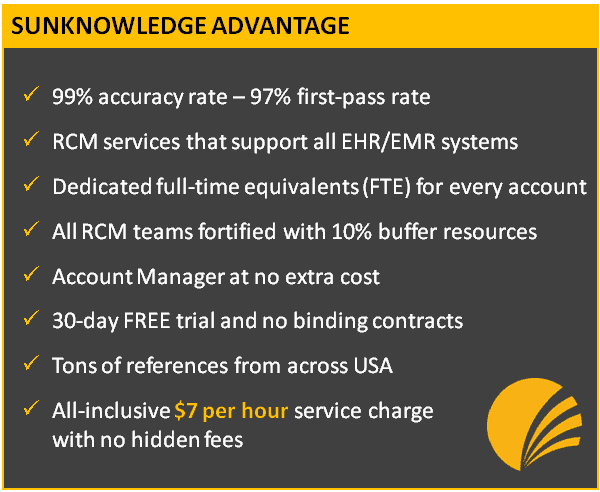
With dedicated gynecology billing specialists, real-time payer policy monitoring, and denial analytics that trace root causes rather than just symptoms, our expertise has helped practices move first-pass acceptance rates from industry-average ranges into the 97 percent range and sustain them there.
Here are some important ways in which we ensure maximum reimbursements for gynecologists.
Implementing Clear Coding Protocols – SunKnowledge works with each practice to develop written coding decision trees for preventive versus E/M billing scenarios that trigger dual billing, when -25 applies, when additional procedure codes can be billed alongside a preventive visit, and when they can’t. These aren’t generic guidelines pulled from a coding manual; they’re practice specific protocols built around the payer mix, provider documentation patterns, and service patterns of that particular practice.
Modifier usage is standardized across the coding team with us, with clear criteria that reduce coder discretion on borderline cases.
Strengthening Documentation Practices – Our clinical documentation support focuses on closing the gap between what providers document and what payers need to see. Provider education sessions address the specific scenarios where documentation ambiguity creates billing risk — particularly around dual-coded visits and additional procedures performed during preventive encounters. Our goal isn’t to make documentation harder for providers; it’s to make it more specific where specificity equates to revenue.
Real-Time Eligibility and Benefits Verification – Every patient scheduled for a gynecology preventive visit goes through a structured verification workflow before the appointment. Our experts check active coverage, plan year status, deductible and out-of-pocket accumulators, specific preventive versus diagnostic benefit coverage, and network tier for the rendering provider.
Payer Policy Tracking System – We maintain a continuously updated payer policy database covering frequency limits, screening age criteria, required diagnosis codes for preventive services, and bundling rules for each major commercial payer and Medicaid program in the practice’s operating market. Policy updates trigger alerts to the coding team within the billing cycle, not at the next denial.
This is one of the higher-leverage operational differences between outsourced gynecology RCM with active policy management versus in-house teams that rely on memory and annual training. Payer rules change. Practices that know they changed before submitting claims stop generating a class of entirely preventable denials.
Claim Scrubbing – Every gynecology claim passes through a multi-layer scrubbing process before transmission. Automated scrubbing catches coding errors, missing modifiers, diagnosis code specificity gaps, and payer-specific format requirements faster. With our secondary manual review, we handle complex encounters dual-coded visits, high value procedures, or claims for patients with non-standard coverage situations easily.
Practices that consistently maintain low denial rates and clean A/R profiles share a set of operational habits that distinguish them from average performers. These aren’t sophisticated technology solutions they’re disciplined processes applied consistently.
Preventive gynecology visits are not an inherently difficult billing category. The codes are well defined, the payer policies while varied are documented, and the documentation standards are clear. What produces chronic denial rates in this category is not complexity; it is the accumulation of small process gaps that individually seem minor but collectively erode a significant portion of what a practice should be collecting.
The path out of that pattern is not to submit more claims faster or to appeal more aggressively after the fact. It is to build the process quality at the point where denials form eligibility verification, coding accuracy, documentation specificity, payer policy awareness so that the claim is clean before it leaves the practice.
SunKnowledge’s gynecology billing services are built around that principle. As payer policies grow more granular and the administrative burden on clinical practices continues to increase, the practices that protect their revenue cycle are the ones with RCM partners who operate at the level of specificity that the work actually requires.
If you are looking for change, connect with SunKnowledge about your gynecology RCM services. Sign up for a free 30-day trial today.