
- June 12, 2026
- Posted by: Josh Knoll
- Category: DME Billing
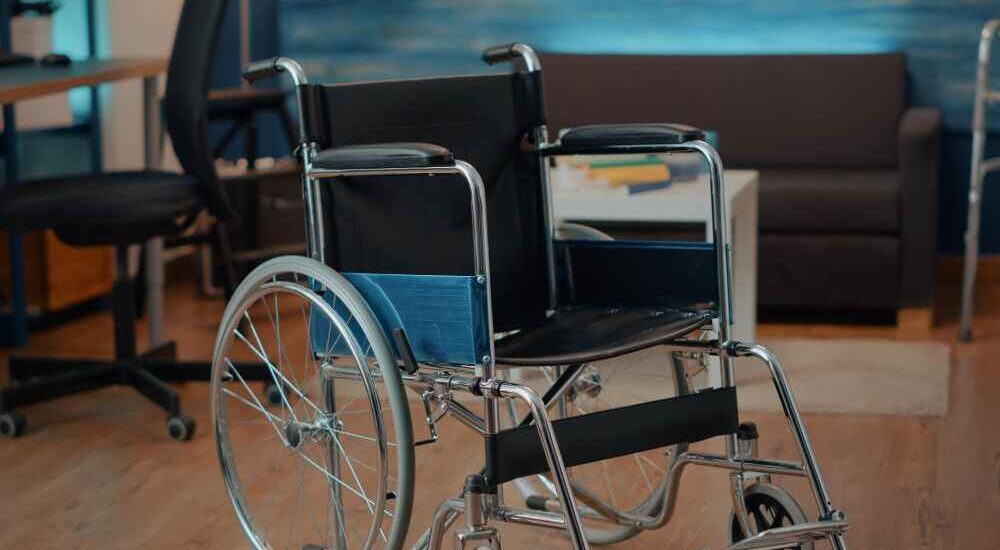
DME is one of those billing categories that looks straightforward on the surface but gets complicated fast the moment a claim hits a payor’s desk.
The basic definition is simple enough. Durable Medical Equipment refers to items patients use at home as part of treatment, recovery, or ongoing care. But from a billing standpoint, the item itself is almost secondary. What matters is whether it actually meets payor criteria, and Medicare and commercial plans have very specific ones. Most DME claim denials don’t happen because the equipment was wrong for the patient. They happen because the paperwork didn’t make the case well enough.
If a claim has vague language, a physician order missing a date, or a diagnosis code that doesn’t directly support the requested item, then it can lead to claim denial. It doesn’t matter how obvious the need was clinically. This is where DME billing gets genuinely difficult. The clinical reality and the documentation reality are two separate things, and they don’t always match up. A patient might absolutely need a power wheelchair, but if the treating physician didn’t document failed ambulation trials or the patient’s functional limitations in specific enough terms, the claim won’t survive prior authorization.
Modifier usage is another area that catches billers off guard. DME claims often require modifiers that indicate whether equipment is being purchased or rented, new or used, and whether it’s a replacement or not. Getting this wrong doesn’t just delay payment, it can trigger audits. Medicare’s competitive bidding program adds another layer. Certain equipment categories now require suppliers to hold contracts in specific geographic areas. Billing for items outside that contract coverage zone is a compliance issue, not just a billing error.
Then there’s the ongoing documentation requirement that many providers underestimate. For rental equipment especially, monthly medical necessity recertification isn’t optional. Missing that window means the rental claims that follow don’t have legs. DME billing rewards people who treat documentation as a clinical function, not an afterthought. These are the reasons clinics take the help of outsourced DME billing services.
What Exactly Is Durable Medical Equipment (DME)?
DME, or Durable Medical Equipment, are the medical equipment used by the patients as part of their treatment, recovery, or ongoing condition management. From a billing standpoint, the equipment alone is not the whole story. What matters just as much is whether that item actually meets the coverage criteria set by Medicare, Medicaid, or the patient’s private insurance plan.
Four conditions have to be met for something to qualify as DME:
- The equipment has to be durable, which means it is designed for repeated use over time, not something disposable or made for short-term use only.
- It has to serve a clear medical purpose, not simply add comfort or convenience.
- The equipment should be used in a home environment rather than in a clinical setting.
- And a physician needs to order it.
Wheelchairs, walkers, hospital beds, oxygen systems, CPAP machines, and prosthetic devices are all standard DME examples. These are not optional purchases for patients using them.
What does not qualify matters just as much. Grab bars, air conditioners, and general fitness equipment might seem beneficial in a broad sense, but payers categorize them as convenience items, not medically necessary for DME. Billing those items under DME gets claims denied fast. Doing it repeatedly can invite a level of scrutiny no supplier wants. Getting the classification right from day one is where clean billing starts.
Related Reading: Choose The Ideal Guide in DME Billing Services
Why DME Is Important
Durable medical equipment plays an essential role in healthcare as it is helpful for patients to get access to the necessary equipment from the comfort of their home.
Helping Patients Recover at Home
The clinical case for DME is not complicated, even if the billing is. When a patient gets discharged from the hospital after surgery, the equipment waiting at home is the recovery plan. A hospital bed that adjusts properly, a walker that prevents a fall, crutches that let someone move around without loading a healing joint — without those items, the patient does not recover safely at home.
Making Patients’ Daily-life Easier
For patients managing long-term conditions, the picture is the same. Someone on daily supplemental oxygen is not using that equipment occasionally. It keeps them functional.
Reducing Hospital Visits
Medicare has understood this math for decades. That is why most DME falls under Part B coverage. Keeping patients stable at home costs less than managing repeat hospitalizations. DME is one of the practical tools that make home-based care possible, and coverage reflects that reality.
How DME Billing Works
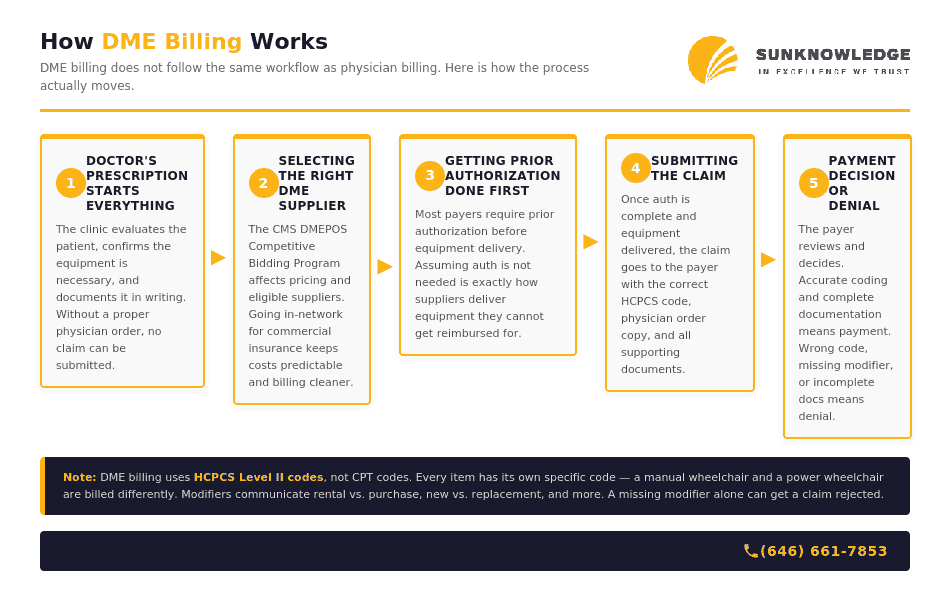 DME billing does not follow the same workflow as physician billing, and that trips up a lot of people who cross over from other areas of medical billing. Here is how the process actually moves.
Step 1: The Doctor’s Prescription Starts Everything
You need to have a physician order before starting any procedure. The clinic first evaluates the patient, confirms if the requested equipment is important or not, and then puts that in writing. So, without this proper documentation procedure, you cannot submit a claim. Payers need precise documentation which a clear prescription can provide.
Step 2: Selecting the Right DME Supplier
The next step comes in selecting the right supplier when the order is in hand. The CMS DMEPOS Competitive Bidding Program affects the pricing and eligible suppliers billing for specific items inside a single area. For patients with commercial insurance, going in-network, when possible, keeps the patient’s out-of-pocket costs predictable and makes the claim process cleaner on the billing side.
Step 3: Getting Prior Authorization Done First
This is where a large number of claims get denied before even the submission procedure. Most payers need prior authorization before even delivering the equipment. The supplier then submits the clinical documents, payer reviews whether the request met the patient’s medical necessity criteria or not, and then approval or denial comes before anything ships. Assuming a prior authorization is not required for a specific item is exactly how suppliers end up delivering equipment they cannot get reimbursed for.
Step 4: Submitting the Claim
After the authorization procedure is complete and the patient gets the necessary equipment, the claim goes directly to the payer. The submission process requires the right HCPCS code for the specific item, a physician order copy, and any additional documents the payer needs to verify a patient’s medical necessity. Getting all of that right on the front end is always faster than chasing a denied claim after the fact.
Step 5: Payment Decision or Denial
The payer reviews the submission and makes a call. When coding is accurate and documentation is complete, claims pay. When something is off, like the wrong code, missing modifier, incomplete documentation, or an authorization that was not obtained, the claim gets denied.
DME billing uses HCPCS Level II codes, not CPT codes except in certain cases depending on the service being billed. Every piece of equipment has its own designated code, and the codes are specific. A standard manual wheelchair and a power wheelchair are billed differently. Modifiers add another layer, communicating to the payer whether equipment is being rented or purchased, whether it is new or a replacement, and other details that affect how the claim gets processed. A missing modifier alone can get a claim rejected without much further explanation.
Who Pays for DME?
Coverage depends on what kind of insurance the patient carries, and the differences between programs are meaningful in practice.
Medicare Coverage
Medicare Part B covers a broad range of DME, but with conditions attached every time. After the annual deductible is met, Medicare typically pays 80% of the approved cost. The remaining 20% is the patient’s responsibility. To get access to Medicare coverage, the equipment has to be medically necessary, physician-ordered, and obtained from a Medicare-enrolled supplier. Any one of those conditions missing puts payment at risk.
Medicaid Coverage
Medicaid covers DME as well, but state-to-state variation is significant enough that it cannot be treated as one uniform program. What is covered in Ohio might not be covered in Florida. Documentation requirements generally follow the same logic as Medicare, but state-specific policies add requirements that vary by market and can change. Staying current on Medicaid rules in each state where a supplier operates is its own ongoing task.
Private Insurance Coverage
Private insurance through carriers like Blue Cross Blue Shield, UnitedHealthcare, and Aetna operates on a plan-by-plan basis. Some commercial plans cover DME generously. Others require co-pays, deductibles, and prior authorizations that go beyond what Medicare asks for. Some plans exclude certain items entirely. Verifying benefits with the payer before equipment is ordered is basic risk management for any DME supplier that wants a predictable revenue cycle.
What Are DME Billing Codes?
HCPCS codes are the foundation of DME billing. Every piece of equipment billed to insurance must be assigned to the correct code, and that code must match the actual item being provided; not something similar or an approximation.
A few that come up constantly include E0601 covers a standard CPAP machine, and E1161 covers a standard manual adult wheelchair. Those two codes alone account for a meaningful share of what many suppliers bill week to week.
CMS updates HCPCS codes every January. Billing with a code that was current eighteen months ago but has been changed is a billing error, regardless of whether the intent was correct. Keeping up with annual updates is part of the ongoing operational reality of DME billing, and it is one of the reasons specialized billing teams come into the picture.
Common Reasons Why DME Claims Get Denied
DME claim denials follow patterns, and those patterns are largely predictable. Here is where most of them actually come from.
Not Having a Doctor’s Prescription
Missing or insufficient physician orders show up at the top of the list. The order has to be current, specific, and written in a way that clearly supports medical necessity for the requested item. Vague language or an order that has expired does not satisfy payer requirements, and reviewers are trained to catch the difference.
Missing Prior Authorization Procedure
Skipped prior authorizations are a close second. Suppliers sometimes assume a particular item does not require authorization, deliver the equipment, and find out weeks or months later that the payer expected a pre-approval that was never requested. That situation is recoverable in some cases, but it is a time-consuming and avoidable problem.
Inaccurate Billing Codes
Incorrect HCPCS codes account for a steady share of denials. DME coding is specific and using a code that is close but not correct, results in a claim that comes back to the billing team for correction before it can pay.
Items Not Having Medical Necessity
Medical necessity documentation gaps are another common driver. The clinical record has to tell the story of why the patient needs the specific equipment that was ordered. If the documentation in the file does not clearly support that need, payers are not obligated to take anyone’s word for it.
Duplicate Claim Submission
Duplicate billing, often the result of a process gap or a system error, still gets claims flagged immediately. Submitting a claim for equipment that was already billed under a prior submission creates a problem that takes time to untangle.
Renting vs. Buying DME: What Actually Makes Sense
The rent-or-buy question comes up constantly in DME, and the honest answer is that it depends on the clinical situation more than anything else.
Renting DME
Renting makes practical sense when the need is short-term. A patient recovering from knee surgery who needs a walker and a hospital bed for eight weeks has no reason to purchase that equipment outright. Rental costs are less upfront, and when recovery is complete, the equipment goes back to the supplier.
Buying DME
Buying makes more sense when the need is ongoing. A CPAP machine used every night for sleep apnea, or a glucose monitor used daily for diabetes management; these are items a patient will need indefinitely. Rental fees accumulate fast for long-term use, and ownership is the more economical path when there is no defined end point.
Medicare handles certain items through a capped rental model. Rental payments are covered for a set number of months, after which ownership transfers to the patient. How that model applies across different item categories is specific enough that it really should be managed by someone who works in DME billing regularly, not guessed at.
Related Reading: How to Optimize Crossover Claims and Secondary Billing in DME
Simple Habits That Keep DME Billing Clean
Staying ahead of DME billing problems mostly comes down to being consistent on a handful of things that matter.
Getting the Doctor’s Prescription
Always start with a complete, current physician order. Everything downstream depends on that order being specific and clearly documenting medical necessity. A weak order makes the claim vulnerable from the start.
Confirming Prior Authorization
Confirm prior authorization requirements before equipment leaves the building; not after, before. That is a straightforward process discipline that prevents a meaningful percentage of avoidable denials.
Double Checking the Insurance Benefits
Keep organized, accessible documentation files for every claim. Physician orders, delivery confirmations, medical necessity records, authorization approvals — all of it. In an audit, that documentation is what determines the outcome.
How SunKnowledge Handles DME Billing for Suppliers Across the Country
DME billing requires a level of specialization that is genuinely hard to build and maintain in-house, particularly when payer rules keep shifting and audit activity from RACs and OIG stays elevated.
SunKnowledge Services works with DME suppliers across the country on the complete billing workflow. The whole workflow includes:
- Eligibility verification
- Prior authorization management
- HCPCS coding
- Claim submission
- Denial management
- Appeal filing
The team stays current on Medicare Part B requirements, tracks Medicaid policy variations by state, and monitors HCPCS code updates annually so that supplier clients are not caught off guard by changes they missed.
The practical result shows up in claim performance. Fewer first-pass denials and faster payment cycles. Documentation that is organized and audit-ready when a review request comes in. SunKnowledge operates as a working extension of the supplier’s operation, handling the billing work with the same attention to detail that good DME billing demands.
For DME suppliers who are done chasing denials, managing authorization backlogs, and second-guessing whether their billing is keeping pace with current payer requirements, the next step is straightforward.
We know how to work with clinic-specific EHR software like Brightree, NikoHealth and CureAR. Each of our experts can tackle 50–55 patient demographic entry per day and 18–20 prior authorization requests. Moreover, our experts also tackle denial management of 30–35 claims and can collect payment of 30–35 patients over the phone.
Visit SunKnowledge today and see how a dedicated DME billing company can clean up the revenue cycle, cut down the administrative load on internal staff, and put reimbursements where they belong, in the bank, on time.