
- June 12, 2026
- Posted by: Josh Knoll
- Category: DME Billing

DME suppliers lose millions in reimbursement every year. And it is not because patients lack coverage but because secondary billing errors quietly drain revenue before anyone notices. Accurate Coordination of Benefits (COB) and proper crossover claim management are not just back-office details today. Instead, they directly determine how much your DME practice collects and how fast.
So, a failed crossover claim does not just delay payment. It creates a cascade of A/R aging climbs, staff chasing payers, denials stacking up, and write-offs occurring. And this is why providers like you need to get your DME billing operation sorted right from the start.
What Is Secondary Billing in DME?
Secondary billing happens when a patient carries more than one insurance plan. After the primary payer processes and pays its portion of a DME claim, the supplier bills the secondary payer for the remaining balance. It then reviews what the primary paid and either covers the remainder or applies its own policies to determine its payment. Getting this sequence right determines whether the supplier collects fully or absorbs the gap for all.
Key Secondary Payer Compliance Guidelines for DME Providers
Medicare as primary payer: Medicare here almost always acts as the primary payer for eligible beneficiaries. It adjudicates the claim first and determines covered amounts, deductibles, and coinsurance. The secondary payer then steps in for what remains.
Commercial insurance as secondary: Many patients carry employer-sponsored commercial plans as secondary coverage. These plans each have their own COB rules. And the DME supplier must submit claims with the correct primary payment information attached.
Medicaid as a secondary payer: Medicaid routinely serves as the payer of last resort. Medicaid will not pay more than what its own fee schedule allows, even if the primary paid less. And if you are a DME provider, at times, Medicaid’s crossover billing rules in each state will vary significantly.
Employer-sponsored plans: Some patients even carry both a government plan as well as an employer-sponsored plan. The order of benefits follows standard COB rules and each plan’s coordination clause must be verified before billing.
How Secondary Billing Works
Claim submission sequence: The primary claim goes out first. Once the primary remittance advice (ERA or EOB) is received, the supplier bills the secondary, including that payment information. Submitting to secondary without primary adjudication documentation is one of the most common reasons why secondary claims are rejected.
Payment coordination: The secondary payer compares what the primary paid against its own allowed amounts and COB logic. Depending on the plan, it may pay a flat copay, cover a percentage of the remaining balance or even deny based on its own exclusions.
Remaining patient responsibility: After both payers have processed the claim, any remaining balance becomes the patient’s responsibility. This is the amount that either gets billed to the patient or written off, mostly depending on the supplier’s policies and any financial hardship arrangements.
What Are Crossover Claims in DME Billing Services?
A crossover claim is a Medicare claim that automatically transfers to a secondary payer after Medicare finishes processing it. Medicare sends claim data directly to the secondary payer via its electronic systems, eliminating the need for the supplier to manually re-file.
This automatic transfer happens when Medicare has a coordination agreement with the secondary payer and the patient’s secondary insurance is on file with Medicare. Here, the Coordination of Benefits Contractor, or COBC, which many know of, manages this process and maintains the database of beneficiary insurance information.
Related Reading: DME Billing Services and HCPCS Accuracy: The Crucial Link
4 Steps of Crossover DME Billing
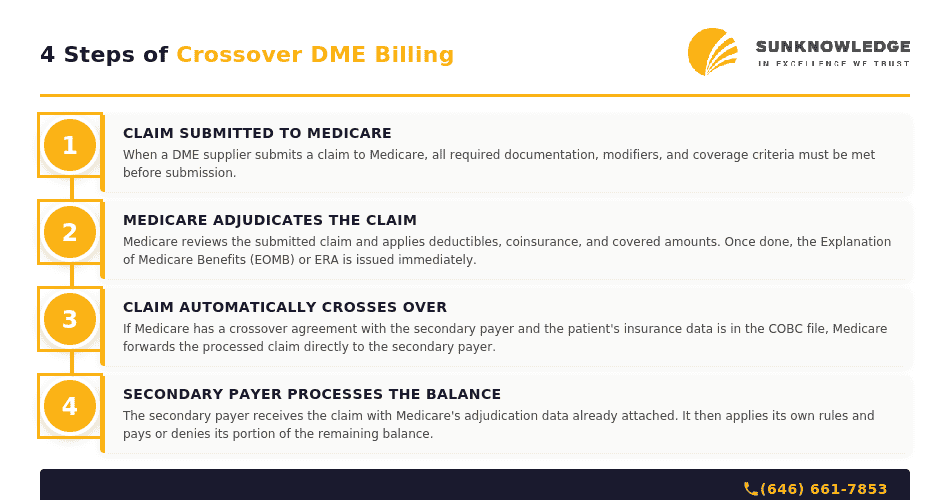 Step 1: Claim when submitted to Medicare: When a DME supplier submits a claim to Medicare, all required documentation, modifiers, and coverage criteria should be met.
Step 2: Medicare adjudicates the claim: Here, Medicare reviews the submitted claim, applies deductibles, coinsurance, and covered amounts. Once it is done, the Explanation of Medicare Benefits (EOMB) or ERA is issued on an immediate basis.
Step 3: Claim automatically crosses over: If Medicare has a crossover agreement with the secondary payer and the patient’s insurance data is in the COBC file, Medicare forwards the processed claim directly to the secondary payer.
Step 4: Secondary payer processes the balance: The secondary payer receives the claim with Medicare’s adjudication data already attached. It then applies its own rules and pays or denies its portion of the balance.
Why Crossover Billing Is Important for DME Suppliers
Faster Payments
When you are working on crossover claims, the secondary payer receives the claim immediately after Medicare processes it without any delay from manual re-filing. If you are a DME provider who relies on manual secondary billing, you often have to wait for weeks between primary adjudication and secondary submission. Crossover eliminates that gap and compresses the payment cycle significantly.
Reduced Administrative Burden
Manual secondary billing requires staff to pull the primary EOB, attach it to a new claim, verify secondary payer information, and re-file for every single claim. Crossover automation removes those steps for qualifying claims. Staff here can redirect that time to claims that actually require manual intervention.
Lower Claim Submission Costs
Every manual claim submission carries a cost of staff’s time, clearinghouse fees, and the risk of data entry errors. Crossover claims reduce the volume of manual secondary submissions, which directly lowers per-claim processing costs for high-volume DME suppliers.
Improved Patient Satisfaction
Patients notice when billing is slow or when they receive unexpected bills because secondary coverage was not pursued. Efficient crossover billing means patients see their full coverage utilized without having to follow up. That means fewer patient complaints and fewer disputes over balances.
Better Cash Flow
For DME providers managing large volumes of Medicare-primary claims, crossover efficiency directly impacts monthly cash flow and the documentation headache. Delays in secondary collections not only extend A/R aging and increase write-offs but also force DME providers to absorb costs they could otherwise recover. A well-managed crossover process keeps cash moving.
Common Secondary and Crossover Billing Challenges in DME
Missing Secondary Insurance Information
If the patient’s secondary insurance is not collected at intake or if it changes without the supplier being notified, the secondary claim cannot be filed. This is one of the most preventable sources of lost reimbursement in DME billing and one of the most common.
Incorrect Coordination of Benefits (COB)
When primary and secondary are filed in the wrong order, both payers typically reject the claim. Getting the COB order wrong wastes time, delays payment and can trigger compliance flags if the pattern repeats across a patient’s claims history.
Medicare Crossover Failures
Medicare crossover fails when the patient’s secondary insurance is not in the COBC database, when the payer is not part of Medicare’s crossover network, or when there is a data mismatch. Suppliers who do not monitor remittance advice carefully will not catch these failures until AR reviews flag them weeks later.
Secondary Payer Rejections
Secondary payers reject claims for various reasons, starting from missing primary EOB data to policy exclusions to duplicate claim flags. Each rejection requires investigation and corrected resubmission, adding cost and extending the payment timeline.
Eligibility Verification Errors
Verifying eligibility only at intake and not at each billing cycle creates risk. Secondary coverage changes more often than suppliers expect — plan renewals, job changes, and Medicaid redeterminations all affect secondary eligibility. Billing for inactive coverage guarantees rejection.
Duplicate Claim Issues
When a crossover claim processes automatically and the supplier also manually refiles to secondary, the secondary receives two claims for the same service. This triggers a duplicate denial even if the original crossover never paid. Tracking crossover status carefully prevents this waste.
Top Reasons DME Billing Crossover Claims Fail
- Secondary Not on File – The patient’s secondary plan was never registered with Medicare’s COBC, so crossover cannot initiate.
- Payer Not in Network – Not all secondary payers participate in Medicare’s crossover program. These require manual billing.
- Patient Data Mismatch – Name, DOB, or member ID on the claim does not match what the secondary payer has on file.
- Invalid Policy Numbers – Expired, incorrect, or reformatted policy numbers cause the secondary to reject the claim outright.
- Medicare Processing Errors – Rare but real errors in Medicare’s adjudication prevent the crossover from transmitting correctly.
- COB Conflicts – When both payers claim they are secondary, the claim stalls. COB disputes require intervention and documentation to resolve.
Best Practices for Managing Secondary and Crossover Billing
Verify Insurance Before Delivery – Collect and verify all insurance information — primary and secondary — before the equipment leaves. This is no doubt the single most effective step to prevent downstream billing failures.
Confirm Coordination of Benefits – Contact both payers to confirm the COB order and ensure Medicare has the correct secondary insurance on file with the COBC. Assuming the patient knows which plan is primary can create a lot of confusion.
Monitor Medicare Remittance Advice – Review every Medicare ERA for crossover indicators. The 835 transaction includes crossover codes that confirm whether the claim was forwarded to secondary. If no crossover indicator appears, manual billing to the secondary is required.
Track Crossover Status – Build a workflow that tracks every Medicare claim with secondary coverage through its full lifecycle from submission to Medicare adjudication to secondary payment or denial. Claims that fall out of this workflow undoubtedly represent unrecovered revenue.
Automate Eligibility Checks – Running automated eligibility checks at regular intervals for active patients, not just at intake, can make a huge difference. Secondary coverage changes happen throughout the year and catching a coverage change before billing prevents a guaranteed rejection.
Follow up on Failed Crossovers Quickly – Time limits on secondary billing are real. Many secondary payers enforce timely filing deadlines of 90 to 180 days. A crossover failure caught at 30 days still leaves time to manually re-file. A failure caught at 180 days may result in a permanent write-off.
How Secondary Billing Errors Affect DME Accounts Receivable
Every secondary billing error increases AR aging. And as AR ages, the probability of collection drops, payers enforce timely filing limits, and older claims get harder to work.
Higher denial rates from secondary billing errors force staff to work the same claim multiple times, pushing denial-related costs up while reducing net collections. Delayed cash flow means suppliers carry unpaid receivables longer, creating pressure on operations. In fact, an increase in write-offs follows when secondary claims miss the timely filing windows or when secondary insurance was never collected.
And hence, your staff workload compounds all of this. A billing team spending disproportionate time on secondary billing corrections has less capacity for proactive claim management, creating a cycle that is difficult to break without structural changes to the billing process.
Why Many DME Suppliers Outsource Secondary Billing
Faster Follow-Up
Outsourced teams build dedicated workflows for crossover monitoring and secondary follow-up. They identify failed crossovers faster and re-file within timely filing windows, something in-house teams stretched across multiple billing functions often cannot do consistently.
Improved Collections
Suppliers who outsource DME billing typically see measurable improvement in secondary collection rates because the team’s entire focus is on recovering those balances. Every dollar of secondary reimbursement collected goes directly to the bottom line.
Reduced Denials
Experienced outsourced DME billing companies submit cleaner secondary claims because they have seen and resolved every common rejection reason. They build eligibility verification, COB confirmation, and crossover tracking into their standard workflow before submission, not after denial.
Specialized Expertise
Secondary and crossover billing in DME involves Medicare MSP rules, state Medicaid crossover requirements, payer-specific COB policies, and COBC data management all at once. In-house teams handling general billing often lack the depth to manage all of this reliably. Outsourced DME billing services like SunKnowledge bring specialists who work exclusively on these claim types.
Related Reading: 5 Powerful Ways Outsourced RCM Vendors Transform DME Billing
How SunKnowledge Makes a Difference
SunKnowledge handles secondary and crossover billing as a dedicated operational function, not as an afterthought to primary claim submission. The team verifies secondary insurance before delivery, monitors Medicare remittance for crossover indicators on every claim, and follows up on failed crossovers within defined timely filing windows all at only $7 an hour.
For suppliers managing high volumes of Medicare-primary claims with Medicaid or commercial secondary coverage, SunKnowledge provides a no-cost account manager and dedicated resources to manage coordination of benefits correctly, including payer-specific COB rules, COBC data management, and state Medicaid crossover DME billing requirements.
With us, DME billing boils down to lower secondary denial rates, faster secondary payments, lower A/R, cleaner claims, and full documentation support for audit readiness. Suppliers who partner with SunKnowledge for outsourced DME billing expertise stop losing revenue to secondary billing errors they never see until it is too late.
Schedule a free consultation today.