
- September 17, 2026
- Posted by: Josh Knoll
- Category: Urgent Care Billing

Speed is the whole point of urgent care facilities. Someone walks in with a sore throat, fever, or flu-like symptoms and within an hour, sometimes within minutes they have been tested, treated, and sent home. A lot of that speed comes down to point-of-care (POC) testing. Resources to conduct rapid strep, diagnose flu, COVID, glucose test and basic metabolic panels are all under the standard practice for any urgent care center rather than a rare add-on. So the point comes down to the billing issues that are quite common here. Moreover, a test may be clinically appropriate and correctly documented but still be denied if the urgent care center does not have the appropriate CLIA certificate or fails to append modifier QW when required. Thus, the urgent care billing teams should verify the test system, code, CLIA status and payer requirements before submitting the claim or else it can create a whole lot of confusion.
According to The Journal of Urgent Care Medicine, of all laboratory tests performed under an urgent care patient visit, more than 85% on average were performed in-house last year, and the average visit with labs involved roughly 2 tests. This indicates the rapid growth of POC testing.
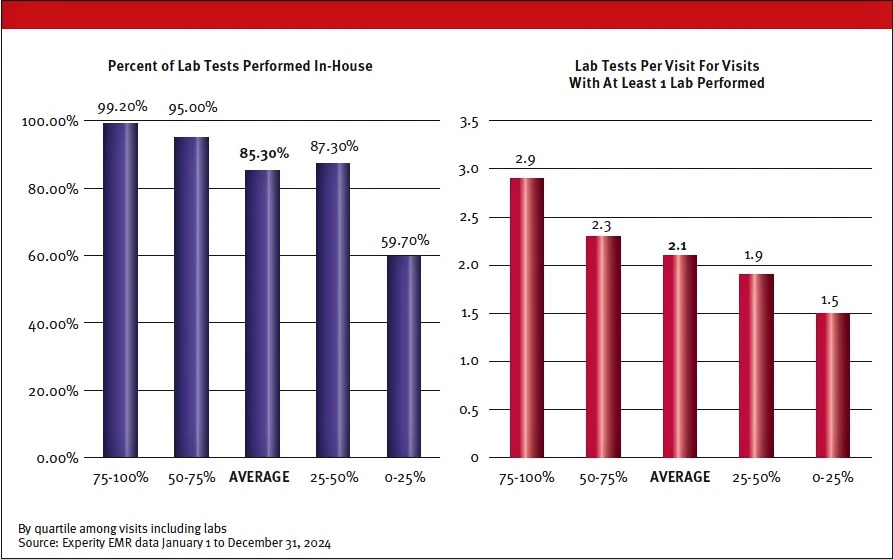
However, the problem is that the urgent care billing excellency or resources have not scaled at the same pace as the testing volume. This is that gap where a lot of urgent care revenue quietly disappears. From coding to documentation management, every step comes with unique challenges as far as POC testing is concerned. And while catering to a vast patient volume, the ability to ensure proper revenue cycle management takes a backseat for practitioners.
This is exactly where expert urgent care billing services take center stage.
Why Point-of-Care Testing Complicates Urgent Care Billing
Theoretically speaking, POC testing looks very simple: run the test, bill the code, get paid. In practice, however, urgent care medical billing for these tests is layered with rules that shift by payer, methodology, and how the test was actually performed and not just what was ordered.
A urinalysis, for example, can carry different CPT codes depending on whether microscopy was involved. Additionally, coders who select a code based on the order rather than the documented method risk a mismatch that triggers a denial down the line.
Bundling creates another challenge. Many commercial payers reimburse urgent care visits under the flat global fee code S9083 rather than itemized E/M codes. Not only that even a growing number of carriers are now automatically bundling common rapid tests, including strep and rapid flu codes into that global fee.
Also, when a clinic bills services without checking its contract, separate test lines may be denied or bundled into the global payment. Conversely, failing to bill separately reimbursable tests can result in missed revenue.
The Data Behind the Denials
The scale of the problem shows up clearly in the numbers. According to Experian Health’s 2025 State of Claims survey, more than 40% of healthcare providers now report that at least one in ten claims is denied. This proportion has increased since Experian’s 2022 survey.
- 50% of providers cite missing or inaccurate claim data as the leading cause, up 4% from the year before.
- And 54% say claim errors are increasing overall.
- More than a quarter of providers say that at least 10% of their denials they face are caused by inaccurate or incomplete data collected at patient intake.
Although the survey was not limited to urgent care or POC testing, its findings mostly show how incomplete patient and claim data can contribute to denials across healthcare organizations.
That trend lands especially hard on urgent care, where front-desk registration happens fast and under pressure. Patients walk in without appointments, insurance gets verified rapidly, and there is little room to slow down and double-check. Coding mismatches sit on top of that same front-end pressure, and point-of-care testing adds its own layer of risk. As more urgent care centers bring diagnostics in-house, the number of billable codes in play grows. And with that, so does the room for error, since every additional test type is another opportunity for a CPT/ICD-10 mismatch, an unbundling issue, or a missed modifier.
Where Urgent Care Billing Breaks Down Most Often
A few patterns recur in urgent care billing audits:
- Methodology mismatches: A test result documented in general terms like “urinalysis performed,” for instance does not tell a coder enough to select the correct code. Without specificity in the chart, coders are left guessing, and guesses get denied.
- Bundling conflicts: A clinic runs and bills a rapid strep or flu test alongside the global S-code the test line may be denied, assigned no separate payment or treated as included in the global reimbursement. The denial may occur not because anything was wrong with the care, but because the contract language was not checked beforehand. The test still happened. The reimbursement just never shows up.
- ICD-10 pairing errors: Sometimes the CPT code assigned is perfectly accurate. However, the claim still bounces back, because the diagnosis code sitting next to it does not back up why the test was medically necessary. At a lower claim volume that is just an easy fix to catch. At a high urgent care claim volume, it slips through constantly.
- Missed modifiers: Required test-related modifiers such as QW for certain CLIA-waived tests may be omitted. Other modifiers may be necessary depending on the test, payer policy and billing circumstances.
Each of these is preventable but only with a workflow built specifically around the realities of urgent care billing. This can be hard to maintain in-house when front-desk and clinical staff are already stretched thin by walk-in volume. This is why the practice of bringing in expert support from offshore companies has gained much traction in today’s times.
How an Experienced Billing Partner Closes the Gap
These are precisely the problems a dedicated urgent care billing partner is built to solve.
Instead of just adding point-of-care testing onto E/M coding and treating it as an afterthought, an experienced urgent care billing team integrates a process of reviewing point-of-care testing. They verify test methodologies in accordance with the documentation before coding the claim, researching any specific payer bundling policies to ensure that the tests are not unbundled. They also make sure to audit CPT/ICD-10 pairings before submitting a claim instead of after receiving a denial.
That difference lies in numbers that matter for the practice, such as clean claims ratio, average days in A/R, and reimbursement collected versus write-offs. Specialty coding review, applied continuously on a large scale, makes the real difference between point-of-care testing revenue risk and margin contribution.
There is also a compliance dimension worth noting. Payers have been increasing scrutiny on how well documentation supports the level of service billed. And point-of-care testing sits squarely inside that spotlight since it generates so many discrete, billable data points per visit. A billing partner familiar with urgent care is not just chasing reimbursement. They are building the kinds of clean audit trail that protects a practice if a payer comes back asking questions months later. This matters just as much as the immediate revenue recovery, especially at multi-location practices where one systemic coding error can multiply across hundreds of charts unnoticed.
The SunKnowledge Advantage in Urgent Care Billing
This is precisely where SunKnowledge earns its reputation. With deep, specialized experience in urgent care billing, including the nuances of point-of-care testing, S9083 bundling logic, and payer-specific coding rules our certified coding and billing teams are built to catch the errors that in-house teams, stretched thin by walk-in volume, often miss.
The numbers back it up:
- Dedicated billing and coding resources for as little as $7 per hour per FTE, which is only a fraction of typical in-house staffing costs, without cutting corners on quality.
- A reported first-pass collection rate of 97%.
- A billing cost reduction of up to 80% for partner practices.
These are the kind of figures that make point-of-care testing move a more reliably managed source of reimbursable revenue. What this means is reduced denials, timely billing, and revenues that come back to the practice rather than remain on a stack of unbilled claims.
There is no need for urgent care centers to opt between providing quick and convenient services and ensuring that the billing is done accurately and with full reimbursements. Team up with a firm whose focus is billing and coding for urgent care clinics and makes point-of-care testing a revenue driver rather than an unknown liability.
For those urgent care centers that want to stop losing revenue, we can help by giving you an evaluation of your billing and coding situation.