
- June 18, 2026
- Posted by: Josh Knoll
- Category: Fertility Clinic Billing

Many fertility clinics lose tens of thousands of dollars each month not because of poor clinical outcomes, but because of preventable prior authorization failures. In fact, it is seen that authorization-related administrative burdens consume a disproportionate share of specialty practice resources, creating revenue leakage that compounds quietly until it becomes a full-scale A/R crisis.
It is no secret that the fertility industry is growing and the IVF demand has surged alongside expanded employer-sponsored fertility benefits. Not to forget the rising infertility rates and growing awareness of options like egg freezing, sperm freezing, and gestational carrier programs. But with that growth comes heightened payer scrutiny. Insurers here have not only tightened IVF coverage criteria but also added medication authorization layers, and built increasingly complex precertification requirements around every stage of fertility care from diagnostic workups through embryo transfer and beyond.
Table of content:
- The Importance of IVF Coverage in Pre-authorization
- What Are the Prior Authorization Requirements for Fertility Treatments?
- 5 Revenue-Impacting Fertility Clinic Billing Issues You Can’t Ignore
- Other Financial Impact of Prior Authorization Failure
- How Outsourced Fertility RCM Handles Common Issues
- Key Performance Indicators Fertility Clinics Should Track
- Why Fertility Clinics Need the Right Billing Partner
The Importance of IVF Coverage in Pre-authorization
Running a fertility clinic billing can be equally challenging and daunting. This is mostly because we are all aware that the clinical reality of the fertility specialty is uniquely high-stakes. Thus, unlike specialty procedures, the IVF cycle billing operates on strict biological timelines. A delayed authorization does not simply slow down a claim; it can cancel a cycle, force medication substitutions, or push a patient out of their optimal treatment window.
On top of that, traditional in-house RCM teams often lack the payer-specific fertility expertise needed to stay ahead of these complexities. And so, the financial and emotional cost of that failure is quite real. This is compounded by coding errors on IVF, ICSI billing, embryology laboratory billing, frozen embryo transfer (FET), and donor egg programs that require a level of specialization that generalist billing staff simply cannot sustain. Thus, an outsourced fertility RCM or a specialized fertility clinic billing company the structured, expert-driven approach that is needed to protect revenue at every authorization checkpoint.
What Are the Prior Authorization Requirements for Fertility Treatments?
It is vital to understand that prior authorization in fertility care is not a single transaction but a multi-stage process involving time-sensitive workflow that runs parallel to clinical treatment. A place where single IVF cycle can require separate authorizations for diagnostic testing, ovarian stimulation medications, egg retrieval, fertilization procedures including ICSI, embryo cryopreservation, embryology laboratory services, and frozen embryo transfer. It is important to remember here that each stage may involve different authorization windows, payer criteria, and requirements for supporting documentation.
And one should not forget employer-sponsored fertility benefits that add another layer of complexity. Plans administered through fertility carve-out vendors, however, carry their own precertification protocols. Thus, a fertility billing team must track these distinctions for every patient and every payer simultaneously.
Also, major payers, including Cigna, Aetna, UnitedHealthcare, and Blue Cross Blue Shield affiliates all apply payer-specific IVF coverage criteria, including infertility diagnosis requirements, prior treatment attempt documentation, age limitations, and cycle quantity caps. And staying current with each payer’s evolving policies is a full-time discipline, not a side task for an overloaded in-house billing coordinator.
The crux of the matter is that managing these complexities is far from straightforward.
Prior authorization for fertility clinics billing undoubtedly involves multiple variables, changing payer requirements, and time-sensitive treatment plans; all of which making it a resource-intensive process. As a result, reproductive endocrinologists (REIs), andrologists, and fertility specialists must remain vigilant about several common pitfalls in prior authorization that can negatively impact both patient care and revenue.
5 Revenue-Impacting Fertility Clinic Billing Issues You Can’t Ignore
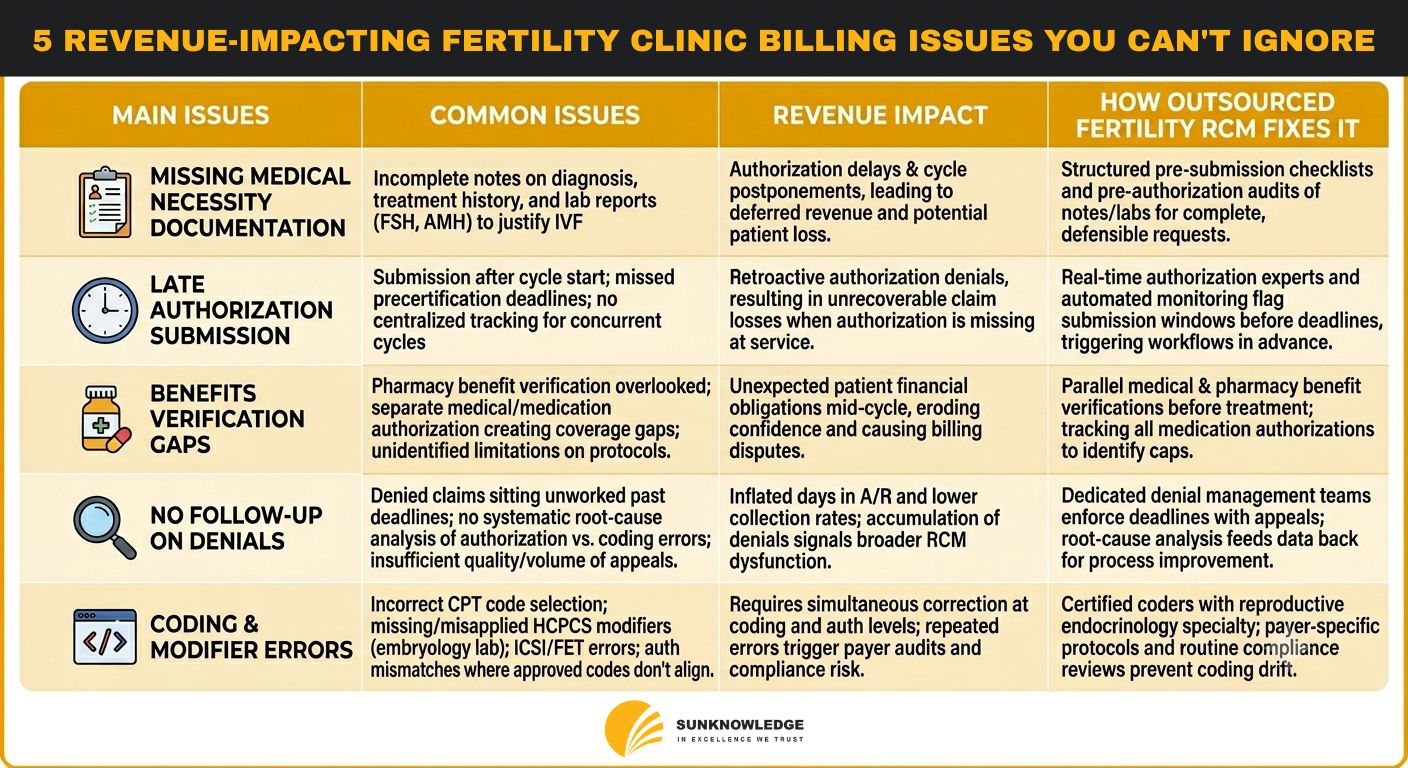
Issue #1: Missing Medical Necessity Documentation
Common Issues
- Incomplete physician notes that fail to establish an infertility diagnosis under the payer criteria
- Missing documentation of previous treatment attempts required for medical necessity
- Absent supporting laboratory reports (FSH, AMH, semen analysis) needed to justify IVF over less invasive options
- Failure to connect diagnostic findings to IVF cycle billing requests
Revenue Impact
It is no secret that authorization delays cascade immediately. Additional documentation requests extend precertification timelines by days to weeks. For time-sensitive IVF cycle timelines, those delays often mean cycle postponements. And as you know, postponed cycles are deferred revenue and in some cases, deferred revenue never materializes if the patient seeks care elsewhere; so it’s a total loss.
How Specialized Fertility Billing Fixes It
A specialized fertility billing service implements structured pre-submission documentation checklists calibrated to each payer’s medical necessity standards. Furthermore, pre-authorization audits review physician notes, lab results, and treatment history before submission, which also helps here. In fact, there are these experts who ensure clinical review workflows align documentation with payer-specific infertility definitions, ensuring every authorization request arrives complete and defensible.
Issue #2: Late Authorization Submission Beyond Payer Windows
Common Issues
- Submission initiated after the cycle has already started
- Missed payer precertification deadlines due to inadequate tracking
- No centralized system to monitor authorization expiration dates across concurrent patient cycles
Revenue Impact
Retroactive authorization denials are among the most damaging revenue cycle events a fertility clinic can experience. So when the authorization is missing at the time of service the resulting claim denial is often unrecoverable.
How Outsourced Fertility RCM Fixes It
Outsourced fertility billing companies deploy real-time authorization experts and dedicated resources who flag upcoming submission windows before deadlines are breached. Automated deadline monitoring runs against scheduled cycle dates, triggering submission workflows in advance of treatment initiation. Dedicated authorization specialists not only own this process, as it is not a shared responsibility layered onto clinical coordinators already managing patient care, but also ease your overall workflow.
Issue #3: Benefits Verification Gaps for Fertility Medications
Common Issues
- Pharmacy benefit verification was overlooked during the precertification workflow
- Fertility medication reimbursement authorization managed separately from medical benefit, creating coverage gaps
- Coverage limitations for stimulation medications, progesterone support, and donor egg program protocols are not identified before dispensing
Revenue Impact
Fertility medication reimbursement failures result in unexpected patient financial obligations that surface mid-cycle. These surprises not only erode patient confidence, generate disputes but often translate into delayed or uncollected balances.
How Fertility Billing Services Help
A comprehensive fertility billing service runs parallel medical and pharmacy benefit verifications before every treatment cycle begins. Medication authorization management tracks every approval here for stimulation protocols, identifies coverage caps and coordinates to prevent gaps.
Issue #4: No Follow-Up on Authorization-Related Denials
Common Issues
- Denied claims sit unworked in the A/R queue past appeal deadlines
- No systematic root-cause analysis to distinguish authorization failures from coding errors or documentation gaps
- Insufficient appeal volume and quality to recover reversible denials
Revenue Impact
Unresolved authorization-related denials directly inflate days in A/R and suppress net collection rates. In fertility billing, where individual IVF cycle claims carry significant dollar values, each missed appeal deadline represents a substantial, permanent revenue loss. Over time, the accumulation of unworked denials signals broader revenue cycle dysfunction to practice leadership and investors.
How Outsourced Fertility Billing Companies Fix It
Outsourced fertility billing companies maintain dedicated denial management teams whose sole function is to recover and prevent claims denials. Appeal tracking systems enforce compliance with deadlines across all payer windows. Root-cause analysis categorizes denials by type authorization failure, coding mismatch, documentation deficit and feeds corrective data back into upstream workflows. And so with this continuous performance monitoring, it not only converts denial trends into process improvements but also reduces future failure rates systematically.
Issue #5: Coding and Modifier Errors
Common Issues
- Incorrect CPT code selection across IVF cycle billing stages
- Missing or misapplied HCPCS modifiers on embryology laboratory billing
- Coding errors involving ICSI billing, embryo cryopreservation, and FET procedures
- Authorization mismatches where approved procedure codes do not align with submitted claims
Revenue Impact
A coding error does not simply result in a rejected claim. It involves more work as a rejected claim with a downstream authorization mismatch requires correction at both the coding and authorization levels simultaneously. Also, repeated coding errors trigger payer audits, creating a disproportionate compliance risk for the practice.
How Fertility Medical Billing Experts Prevent It
Fertility center billing has certified coders with active, specialty specific training in reproductive endocrinology procedure sets. In fact, experts like us at SunKnowledge’s fertility billing team operate under payer-specific coding protocols that account for coverage variations across major and employer-sponsored plans. Routine compliance reviews identify coding drift before it reaches the claim submission stage, protecting both revenue and audit risk.
Read More:
6 Effective Strategies to Reduce Fertility Clinic Denials and Increase Revenues
Other Financial Impact of Prior Authorization Failure
The aggregate cost of prior authorization failure in fertility practices is consistently underestimated. Industry analysis of specialty practice revenue cycle performance points to several measurable cost categories, starting from:
1) Staff hours:
Any authorization related tasks undoubtedly consume a lot of resources’ time that could otherwise be directed toward claim submission, collections follow-up and even patient care here.
2) Reimbursement delays:
Authorization failures that extend the average days to payment for IVF cycle billing and related fertility services can be equally challenging when trying to catch up on the cash flow.
3) Rework cost:
Each retroactive denial, coding correction, or appeal requires additional administrative effort that was already expended on the original submission. Thus, doubling labor cost without adding revenue.
4) Permanent revenue leakage:
Denials not appealed within payer windows, and authorizations not obtained before cycle start, generate losses that are not recoverable through even any downstream process.
There is no doubt that for a fertility clinic billing processing significant monthly IVF and FET volume, these costs compound quickly. And preventable authorization failures are not a marginal inefficiency anymore, but a structural revenue threat and so expertise can be quite beneficial here.
How Outsourced Fertility RCM Handles Common Issues
The structural advantages of a specialized fertility billing service over in-house RCM become clear when compared across the dimensions that matter most to revenue performance:
| Aspect of RCM | In-House RCM Team | Specialized Fertility Billing |
|---|---|---|
| Authorization Expertise | Generalist staff, limited fertility payer knowledge | Dedicated fertility billing specialists with payer-specific protocols |
| Benefits Verification | Manual, inconsistent coverage checks | Comprehensive verification including pharmacy and employer fertility benefits |
| Coding Accuracy | High error rate on CPT/HCPCS for IVF, ICSI, FET, cryopreservation | Certified coders trained in fertility-specific code sets and modifiers |
| Denial Management | Reactive; appeals often missed | Proactive denial tracking with root-cause analysis and appeal pipelines |
| Scalability | Constrained by headcount and training cycles | Scales instantly with clinic volume and seasonal demand |
| Technology Access | Legacy systems with limited integration | Advanced RCM platforms with real-time authorization and claim tracking |
| Reporting & Analytics | Basic or ad hoc reporting | KPI dashboards: approval rates, A/R days, denial trends, revenue per IVF cycle |
Key Performance Indicators Fertility Clinics Should Track
Effective fertility billing outsource relationships are measurable. And clinics should hold their billing partner accountable to defined KPIs that reflect authorization management performance and overall revenue cycle health in terms of:
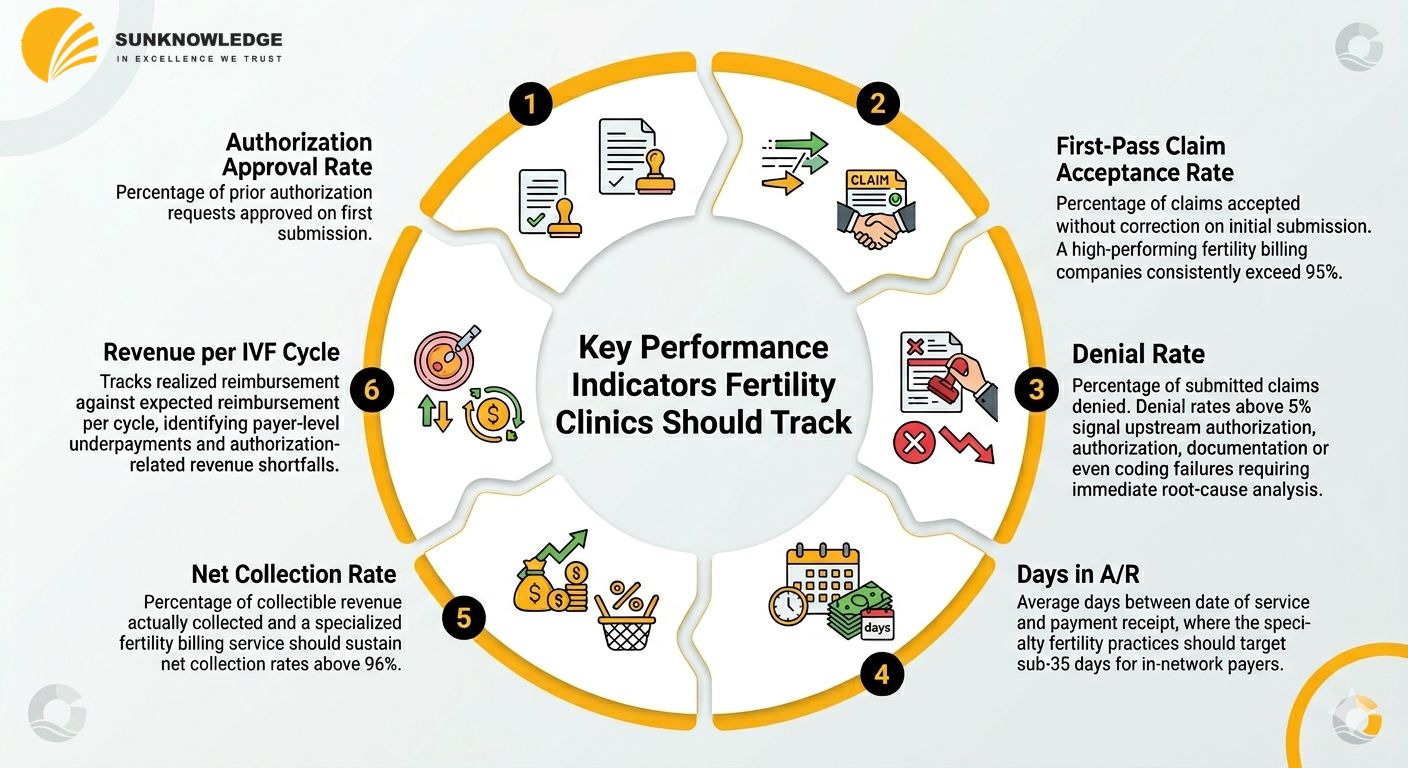
- Authorization Approval Rate: Percentage of prior authorization requests approved on first submission.
- First-Pass Claim Acceptance Rate: Percentage of claims accepted without correction on initial submission. A high-performing fertility billing companies consistently exceed 95%.
- Denial Rate: Percentage of submitted claims denied. Denial rates above 5% signal upstream authorization, documentation or even coding failures requiring immediate root-cause analysis.
- Days in A/R: Average days between date of service and payment receipt, where the specialty fertility practices should target sub-35 days for in-network payers.
- Net Collection Rate: Percentage of collectible revenue actually collected and a specialized fertility billing service should sustain net collection rates above 96%.
- Revenue per IVF Cycle: Tracks realized reimbursement against expected reimbursement per cycle, identifying payer-level underpayments and authorization-related revenue shortfalls.
There is no doubt that the prior authorization in fertility care has evolved from an administrative formality into one of the highest-risk revenue cycle functions a clinic manages. Be it missing medical necessity documentation, late submission timing, coding and modifier errors, medication benefits verification gaps or even unresolved denial backlogs; each of these five traps individually costs clinics significant revenue. And so together, they compound into a systemic problem that in-house billing teams – without specialized fertility billing expertise – struggle to resolve.
So authorization management is no longer just a back-office workflow when you are billing for the IVF cycle or working on ICSI billing, gestational carrier billing or even donor egg programs; getting it right requires expertise.
Why Fertility Clinics Need the Right Billing Partner
SunKnowledge has spent over 16 years building exactly that expertise. Our fertility billing service teams manage prior authorization across the full spectrum of fertility care from egg freezing and sperm freezing through complex gestational carrier billing and self-pay package management, with the same rigor and accountability we work on every engagement. And the result is not only fewer denials, faster payments, and stronger KPIs but a revenue cycle that no longer leaks.
Request a free fertility billing audit today. Authorization failures and revenue leaks are often invisible until they reach critical mass. SunKnowledge’s complimentary fertility billing audit identifies exactly where your practice is losing money and provides an actionable path to recovery.
So call us right now and discover how a specialized fertility billing company can improve your reimbursement performance, reduce your A/R, and protect the revenue your clinic has earned. Contact SunKnowledge today to get started.