
- August 5, 2026
- Posted by: Josh Knoll
- Category: Fertility Clinic Billing

Fertility practices have always faced unique administrative and reimbursement challenges. All because of complex insurance coverage, evolving regulatory requirements, and the specialized nature of reproductive healthcare. Managing fertility billing, in fact, requires extensive insurance verification, prior authorizations, accurate coding, and detailed documentation.
In certain cases, the coverage policies vary across insurers, state mandates, and individual benefit designs. This makes it difficult for a reproductive endocrinologist or an REI reproductive endocrinology and infertility specialist to determine patient eligibility and financial responsibility. Thus, a fertility billing company can benefit providers in more ways than one, particularly by reducing claim denial rates.
An in-depth analysis of fertility billing
In the healthcare industry, fertility refers to the area of medicine specializing in the ability to conceive, maintain a pregnancy, and address conditions that affect human reproduction. To manage the health condition of infertility, there are several clinics dedicated to treating patients with assisted reproductive technology (ART), IVF and more. While providing the services to patients, clinics must ensure they receive proper payments for IVF, IUI, hormone testing, egg freezing, or ultrasound monitoring, and others. A fertility billing company can effectively manage reimbursement for almost all such services.
What makes fertility billing different
There is a striking difference between fertility treatment and other healthcare specialties. As other specialties like cardiology and ophthalmology focus on treating patients suffering from a medical condition. Fertility treatment primarily addresses infertility and reproductive health conditions while improving patients’ chances of conception. While treatment in many specialties addresses urgent or medically necessary conditions, the clinics here mostly deal with achieving successful pregnancy.
It is also important to note that it is significantly different from other healthcare specialties. This is mostly because it involves specialized reproductive healthcare services, complex treatment cycles, multiple providers, and unique insurance requirements. In fact, some of the major areas in which it differs from other specialties are:
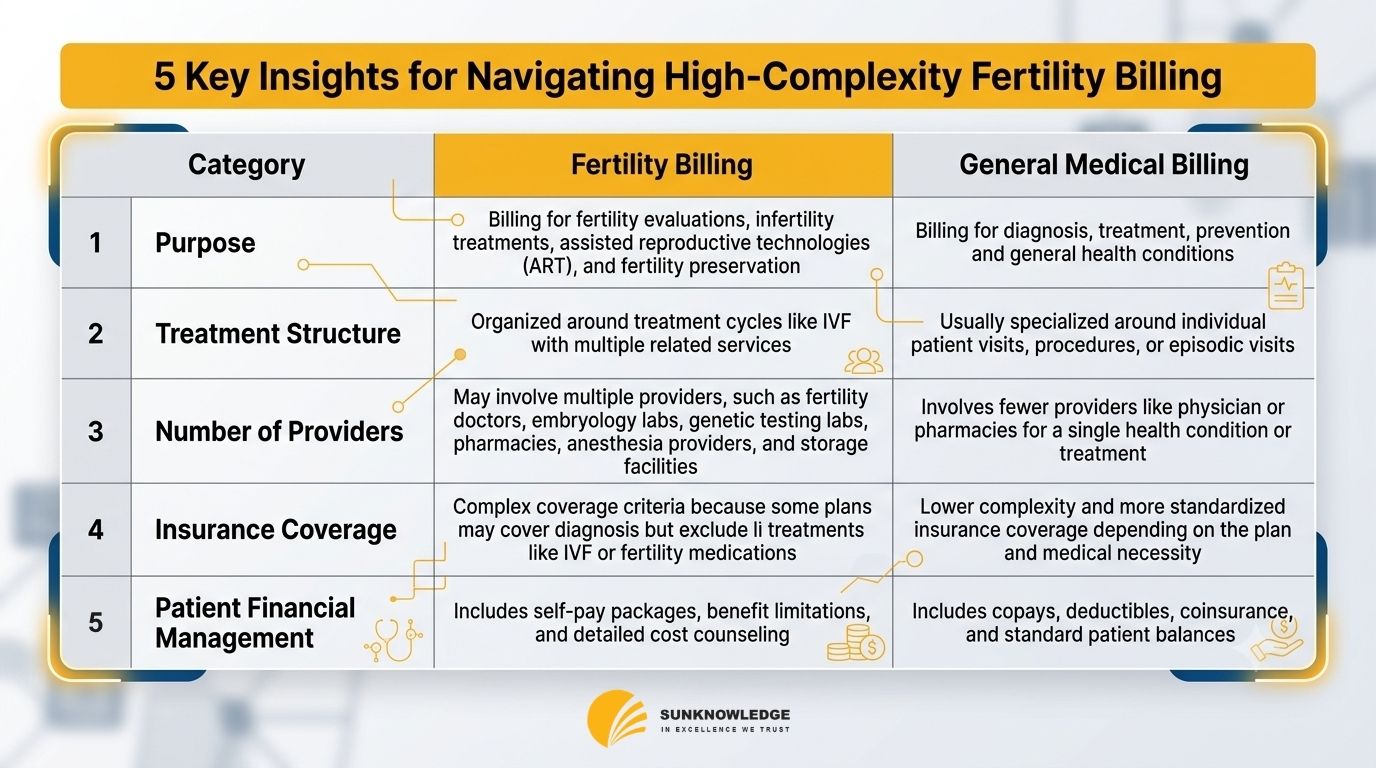
 The 12 phases of the fertility reimbursement process:
Today, ensuring seamless reimbursement can be difficult, as the billing workflow involves the biller following and capturing all services rendered, verifying insurance plans, and reconciling bills for fertility treatments. In fact, a fertility billing company for successful revenue generation ensures the following processes are correctly covered:
1) Patient registration:
When a patient schedules an appointment with the clinic or assisted reproductive technology (ART) center, the billing team records patient demographics, insurance information, referring provider details, and diagnosis information.
2) Insurance verification
After the documentation of patient details is taken, the billing team verifies whether the services suggested are covered, their prior authorization requirements, and lifetime benefit limits.
3) Coding:
The coders prepare claims by converting the services and procedures into standardized alphanumeric codes as female infertility is represented by the code N97.9 and male infertility by N46.9. The procedure codes like 58970 and 58974 are used for follicle aspiration and embryo transfer, respectively.
4) Initial consultation billing:
When patients visit fertility clinics, the services like ultrasound, hormone testing, semen analysis, and diagnostic lab work are billed. This is where the billing team creates a claim using CPT and ICD-10 codes.
5) Prior authorization:
Clinics often need approval before providing services to patients. These services include treatments such as IVF, IUI, genetic testing, and egg freezing. The billing team verifies if the services are covered in the patient’s insurance plan. This helps avoid claim denials that may arise if the insurance plan does not cover a specific fertility treatment.
6) Fertility medication billing:
It refers to the process of charging, submitting, and managing payments for medications used in this treatment. The medications prescribed to patients are provided by specialty pharmacies associated with fertility care. These medications are billed separately for reimbursement and sent to the patient’s insurer. Some of the commonly prescribed medications include gonadotropins, progesterone, and hormonal medications.
7) Treatment cycle billing:
This is what differentiates fertility billing from general medical billing. Infertility treatment involves certain treatment cycles like IVF, which are billed for reimbursement. In the case of an IVF cycle, here, the first three days are part of the stimulation process. This includes services like blood tests, ultrasounds, and even monitoring visits. After the stimulation process, clinics submit claims for egg retrieval and embryo transfer.
8) Charge capture:
The objective of this process is to record all the services provided to patients. The documentation of the services is completed with the help of physician notes, ultrasound records, embryology lab records, and medication administration records.
9) Claim submission:
The coded claims are submitted electronically to the insurance company for payment. A fertility billing company ensures the claim includes correct information and accurate codes. The claims are submitted within the timely filing limit, which refers to the deadlines for claim submissions.
10) Denial management:
After the claims are submitted, the insurer either approves or denies them. Once a claim is denied, the billing team identifies the error, corrects the claim, and resubmits it for reimbursement.
11) Patient billing:
The payer sends a statement to the patient that includes the type of service, total charge, insurance payment, adjustment, and patient balance. Patients have the option to pay their amount with a credit card, fertility package financing, and HSA/FSA funds.
12) Payment posting:
This stage of the process is where the billing team posts payments from insurers, patient payments, adjustments, and refunds. Payment posting is critical for maintaining correct patient balances and accounts receivable days.
Why are fertility claims denied by payers?
It is no secret that most practitioners here struggle with getting payments on time because of a high rate of claim denial. These denials occur due to the following reasons:
1) Documentation errors:
Recording patient data and services must be accurate because documentation serves as the foundation of claim submission. Missing clinical documentation, such as physician notes, incorrect patient identifiers, or authorization details are major reasons why fertility claims are denied. Insurance companies require documentation demonstrating that a service was medically necessary before approving payment. This can only be demonstrated through accurate documentation and proper coding practices. In fact, the claim submission process involves a multi-step process that may span several months, including specialized testing, hormone management, and obtaining prior authorization from payers before treatment begins. Inaccurate patient data and insufficient treatment documentation are among the primary causes of claim rejections in such billing.
2) Coding and modifier inaccuracies:
Most fertility practices struggle to implement the correct use of medical codes. For example, a claim is denied when an embryo transfer claim is billed with an unrelated diagnosis code. Incorrect use of professional and technical component modifiers is also a major reason for claim denials. Fertility clinics rely on a wide range of standardized medical codes, including AMA-published CPT codes, ICD-10 diagnosis codes, and HCPCS codes, to accurately report laboratory services, imaging, and other treatment procedures. Frequent changes to medical coding requirements make it challenging for clinicians to remain current with coding updates.
3) Staffing shortages:
Maintaining sufficient staffing capacity remains a major challenge for many practices here. Staff shortages in assisted reproductive technology (ART) centers or reproductive endocrinology practices are quite common here and contribute to increased workloads. Moreover, billing for fertility services, which involves navigating fertility-specific procedure codes, IVF treatment processes, insurance benefit verification, and insurer-specific infertility reimbursement policies, requires specialized expertise. The nature of these responsibilities makes it difficult to attract and retain qualified professionals for internal billing teams.
4) Changing payer policies:
You must have observed how difficult it is to adhere to the different insurance company policies for fertility billing services. Even today, limited insurance coverage remains a major barrier to accessing treatment.
Frequent changes in payer policies make it challenging for internal billing teams to keep pace with evolving coverage requirements. Furthermore, the treatment cycles may be postponed. The prescribed IVF medication dosages may require adjustment, or additional procedures may become necessary based on diagnostic test results. Insurance coverage requirements vary across states, with some insurers reimbursing basic fertility evaluations while excluding coverage for advanced treatments. These variations necessitate patient-specific benefit verification, increasing the complexity and workload of billing operations.
The challenges that you face in the fertility reimbursement process are the reasons why you are struggling to get timely reimbursement. If your in-house billing team is struggling to reduce errors in claim submission, it is time you outsource the task to a third-party fertility billing company. These third-party firms offer seamless billing operations that not only reduce claim denials but also support HIPAA-compliant billing workflows. For better clarity, let us understand how an outsourced billing company functions to reduce claim denials.
The role of an outsourcing expert in reducing claim denials
A third-party fertility billing company has the following advantages that help in reducing denials:
1) Niche-specific expertise:
Where your in-house billing team struggles, an outsourced firm excels. The third-party firms have in-depth knowledge of CPT, ICD-10, and HCPCS codes that are specific to such care. They are also well-acquainted with the billing requirements for procedures such as IVF, IUI, embryo transfer, etc. Higher coding accuracy results in lower claim denials.
2) Knowledge of payer-specific policies:
It is true that different insurance companies have specialized coverage criteria, documentation requirements, and reimbursement policies. The outsourced companies have trained staff members who continuously monitor policy updates and ensure that claims are in compliance with payer-specific guidelines.
3) Accurate documentation and coding:
Most outsourced companies have certified coders who ensure coding accuracy before submitting claims. The billers also review clinical documentation to confirm that it supports the billed fertility services. With complete and accurate documentation, the chances of claim denials in your practice are reduced.
4) Claim scrubbing:
The fertility billing outsourcing company review claims thoroughly before they are submitted for payment. They use automated processes to identify coding errors, missing modifiers, or incomplete patient information. This identification of errors before claim submission increases the first-pass claim acceptance rates, which is a major KPI in fertility billing.
How SunKnowledge makes a difference in your revenue cycle management
If you are aiming for profit maximization, there are a few factors that you need to consider. The services you provide to patients must be reimbursed on time to ensure the sustainability of your practice. The billing process should also adhere to HIPAA rules to protect the confidentiality of patient information. Additionally, every single billing process, starting from patient registration to payment posting, must be done with accuracy.
If you are struggling to get all these factors, it is time you consider taking our support. At SunKnowledge, we offer dedicated account managers, CPC-certified coders, and buffer resources to take care of all your billing needs. As an established revenue cycle management company with over 17 years of experience providing medical billing services, we also have excellent client references. Get in touch with us now to experience a streamlined and effective billing process for your fertility care.