
- June 23, 2026
- Posted by: Josh Knoll
- Category: Accounts Receivable

Many healthcare organizations assume that once claims are approved and payments are received, the revenue cycle process is complete. Unfortunately, that assumption often leads to significant financial losses. Paid claims do not always equate to accurate reimbursement. There are other factors that need to be considered, such as underpayments, contract discrepancies, coding issues, reimbursement variances, and payer policy changes. All these factors frequently result in healthcare providers receiving less than they are contractually owed. This hidden loss of income, known as post-payment revenue leakage, can impact profitability even when denial rates remain low and collection performance appears strong. Effective healthcare accounts receivable management requires organizations to look beyond denied claims. They need to prioritize payment accuracy, revenue integrity, and reimbursement optimization. Healthcare companies can find untapped income streams; recoup lost reimbursement and improve their overall financial performance. Medical accounts receivable outsourcing services can further support reimbursement accuracy and enhance their collection performance Healthcare leaders often estimate RCM performance through conventional metrics such as: While these indicators remain important, they only tell part of the financial story. A claim may be approved and paid yet still fails to deliver the full reimbursement a healthcare organization is entitled to receive. In today’s increasingly complex reimbursement environment, payment inaccuracies can quietly erode profitability without triggering any obvious warning signs. Payer contracts have become more complicated and reimbursement regulations continue to evolve. Healthcare organizations must modify their focus from merely securing claim payments to ensuring every payment is accurate. Denial management often receives a lot of scrutiny from CFOs, physician practice administrators, and healthcare executives. Denied claims, after all, indicate substantial revenue at stake. However, payment accuracy is a crucial concern that is frequently disregarded. Even if a claim successfully completes the reimbursement method and is paid by the payer, there may perhaps still be RCM irregularities that lower returns. These discrepancies may result from erroneous contract interpretation or mistakes in payment computations. They might also stem from changes to reimbursement criteria, or reductions related to coding. The result is a hidden financial drain that accumulates over thousands of claims. Quick Statistics This mounting bottleneck has elevated healthcare accounts receivable management from a collection-focused function to a strategic financial priority. Revenue that healthcare companies are unable to receive even after being reimbursed for services performed is referred to as post-payment revenue leakage. Stated otherwise, the reimbursement amount is less than what should have been obtained in accordance with contractual agreements, coding requirements, or reimbursement procedures, even though the claim is authorized and paid. Common examples include: One of the most frequent causes of revenue leakage is payer underpayment. Numerous healthcare organizations are short of the technology and resources necessary. Comparing actual reimbursement against projected payment amounts among several submitted claims. Therefore, underpayments are commonly overlooked. Over time, small discrepancies mount up into extensive financial losses. Payer contracts frequently contain: Without rigorous monitoring, organizations may struggle to verify whether payers are complying with contractual obligations. Contract management failures can lead to recurring reimbursement shortfalls that directly impact financial performance. Strong Healthcare Accounts Receivable Management processes help ensure that contract terms are consistently enforced. Clinical documentation and coding precision contribute significantly in reimbursement success. Incomplete documentation increases the chances of lower-acuity coding. While coding inaccuracies may perhaps prevent providers from receiving entire payment for services rendered. Even when reimbursements are authorized, errors in documentation will reduce the amount of revenue collections. Organizations that focus more on coding quality often experience improved revenue integrity and increased revenue retention. Many providers actively appeal denied claims but overlook partially paid claims. Partial payments may contain reimbursement errors that qualify for reconsideration or appeal. When these opportunities are ignored, healthcare organizations effectively leave money on the table. A proactive review process can uncover significant reimbursement recovery opportunities. Modifiers put across essential details about services rendered and frequently have an impact on reimbursement outcomes. They can also affect payment calculations, making accurate modifier usage, critical to guarantee proper compensation. Similarly, payer-generated adjustments may perhaps not always synchronize with negotiated contract terms and conditions. Regular auditing helps identify and correct these issues before revenue losses become widespread. Payers repeatedly revise the reimbursement methodologies, coverage guidelines, and payment regulations. Failure in adapting to the ever-evolving payer policies can result in unforeseen reimbursement losses for healthcare organizations. Continuous monitoring is essential to maintain payment accuracy. Perhaps the most significant contributor to revenue leakage is the absence of systematic post-payment review processes. Many organizations focus heavily on claim submission and denial prevention but devote limited resources to validating payment accuracy after reimbursement occurs. Revenue integrity reviews help identify: Medical Accounts Receivable Outsourcing Services often provide specialized expertise in these areas. Revenue leakage often remains hidden because traditional revenue cycle metrics appear healthy. Watch for these warning signs: Disproportionate write-offs will signal reimbursement bottlenecks or contract management challenges. Comprehensive healthcare accounts receivable analysis can help in revealing fundamental reimbursement issues and categorize concealed revenue leakage. It also helps to become aware of payment variances, boost revenue integrity efforts, and recover the entire financial performance. An inclusive revenue optimization program combines people, procedures, knowledge, and analytics. 1) Boost Contract Management: Companies should keep up-to-date contract databases and conduct routine payer compliance checks. This helps guarantee that payment complies with the conditions of the agreement. 2) Implement Routine Underpayment Analysis: Recurring reimbursement disparities can be found by comprehensive underpayment detection before they develop into significant financial problems. 3) Conduct Post-Payment Reviews: Regular audits facilitate validating payment precision and reveal overlooked reimbursement opportunities. These reviews should become a standard component of Healthcare Accounts Receivable Management. 4) Establish Cross-Functional Revenue Integrity Teams: Revenue integrity requires collaboration across multiple departments, including: Cross-functional teams can identify issues more effectively and implement corrective actions. Ensuring accurate and timely reimbursement for rendered services is critical for sustaining practitioner’s operational competence. This is why hiring expert billers is necessary. When you are looking for expert services, you need to make sure your appointed billing partner should do what they are supposed to do, such as: Given the billing staff shortage in the US healthcare domain, outsourcing healthcare accounts receivable management services to offshore companies has become a common practice among practitioners. On top of that, several financial and operational benefits these offshore companies provide are undeniably lucrative. Starting from their price point, many RCM vendors offer their services through a financially efficient service model and even offer a free account manager. Such personnel specifically help with ensuring a proper communication pathway among the billers and the practitioner. Furthermore, these outsourced billing companies have certified coders in-house who help with clean claim submission and first-pass claim collection rates. For example, RCM solution provider SunKnowledge has a high first pass claim collection rate of 97%. Additionally, apart from billing cycle-related tasks, these companies offer several extra benefits. For example, some provide virtual assistant services, which can be beneficial for administrative functions like fax management. One of the key advantages of collaborating with a professional and a specialized provider for medical accounts receivable outsourcing services like us offers several benefits. Improved transparency into outstanding claims and payer reimbursements help the healthcare organization to strengthen their revenue cycle. Moreover, SunKnowledge’s experienced accounts receivable professionals personally keep an eye on: Our proactive approach as mentioned above helps healthcare organizations minimize aging receivables and improve the overall revenue cycle. A dependable and professional healthcare accounts receivable company also capitalizes on superior reporting and analytical tools to monitor key financial metrics. It enables the providers to make up to date data-driven resource allocation decisions. By outsourcing healthcare, accounts receivable management, practices can minimize organizational workloads on internal workforce. At the same time, it gives a free hand to the physicians on more patient centric care. Additionally, expert and dedicated teams managing medical accounts receivable are extremely well-versed in: In due course, investing in expert medical accounts receivable outsourcing services can endorse long term financial stability. In addition, it will even revise and simplify operational needs, and support constant organizational expansion in the long term. Post-payment revenue leakage is the loss of earned revenue that healthcare providers fail to collect despite claims being approved and paid. It typically results from payment inaccuracies, underpayments, or contract compliance issues. Organizations can identify underpaid claims through contract modeling, payment variance analysis, post-payment audits, and advanced Healthcare Accounts Receivable Management solutions. While revenue reliability prioritizes guaranteeing payment precision and recovering compensation lost due to underpayments and payment mistakes. Denial management is designed to recover income from unpaid claims. Periodic post-payment audits conducted monthly or quarterly are beneficial for most organizations. It depends on payer mix, specialist complexity, and claim volume. Payer underpayments, improper contract applications, mistakes in coding, documentation inaccuracies, modifier coding mistakes, shifting payer policies, and insufficient post-payment review procedures are common reasons.Table of content:
The Hidden Gap between Payment and Profitability
The Revenue Problem Most Healthcare Leaders Never See
What “Revenue Leakage” Means After Claims Are Paid
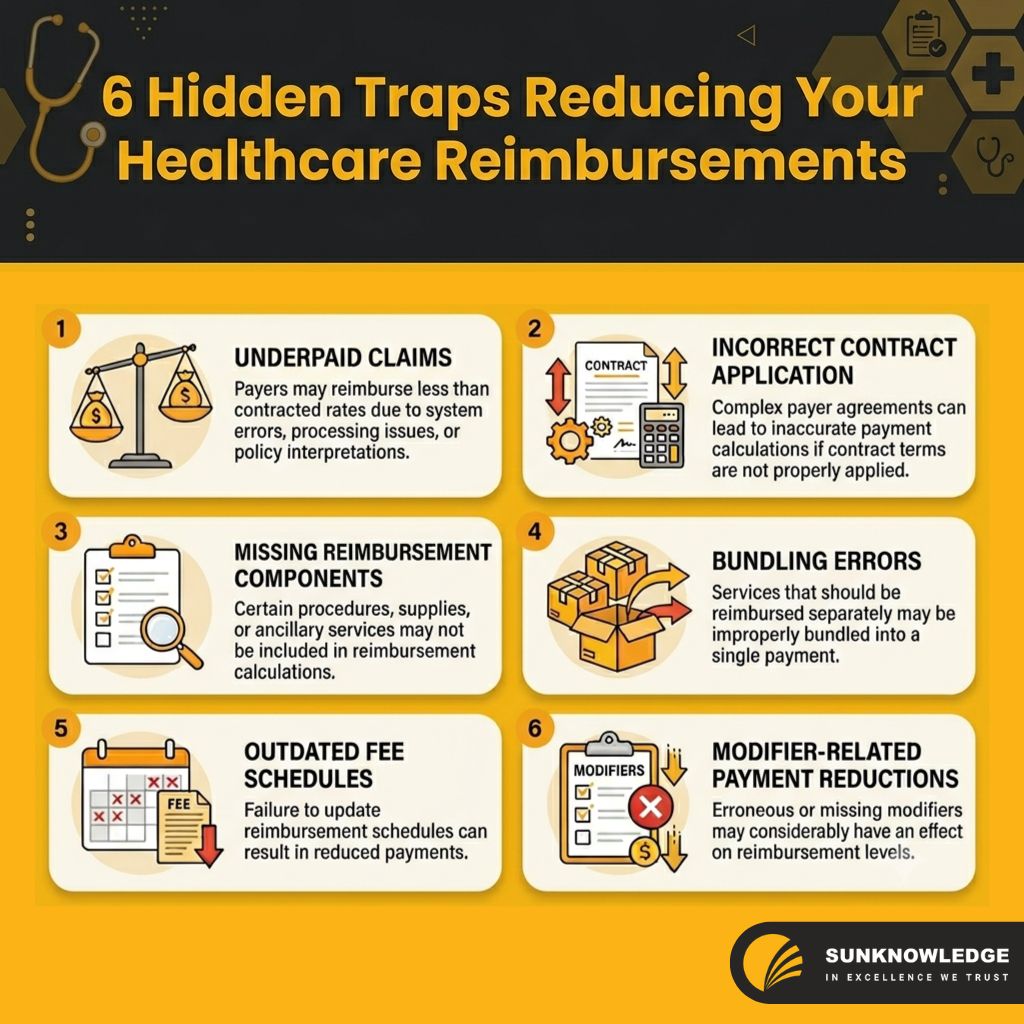
Key Healthcare Accounts Receivable Challenges That Lead to Revenue Loss after Payment
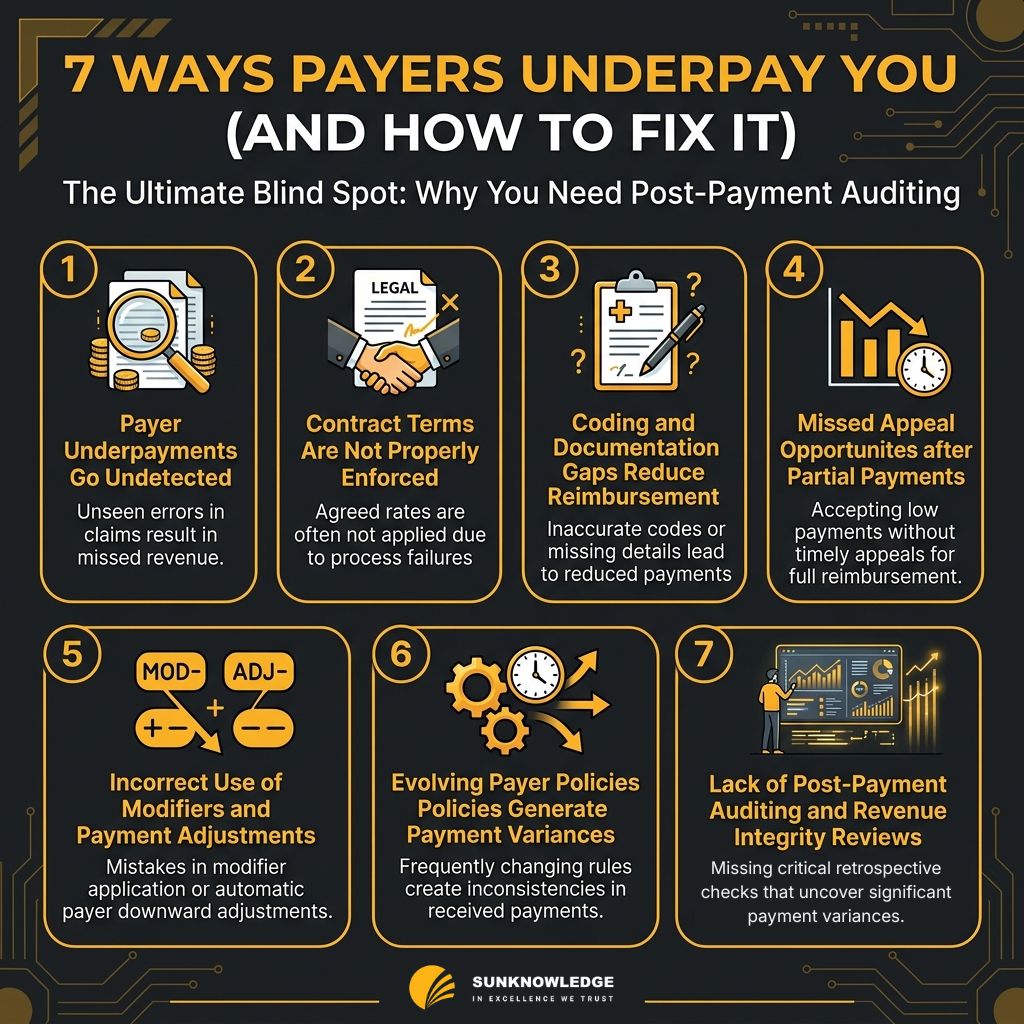
1) Payer Underpayments Go Undetected
2) Contract Terms Are Not Properly Enforced
3) Coding and Documentation Gaps Reduce Reimbursement
4) Missed Appeal Opportunities after Partial Payments
5) Incorrect Use of Modifiers and Payment Adjustments
6) Evolving Payer Policies Generate Payment Variances
7) Lack of Post-Payment Auditing and Revenue Integrity Reviews
Warning Signs Your Organization May Be Losing Revenue despite Strong Collection Rates
Implementing Revenue Integrity Best Practices to Improve Financial Outcomes
Key Factors for Identifying the Best Healthcare Accounts Receivable Management Company
Strengthen Revenue Cycle Performance with the Right Medical Accounts Receivable Outsourcing Partner
The Benefits of Using Medical Accounts Receivable Outsourcing Services
Frequently Asked Questions (FAQ) :
What is post-payment revenue leakage in healthcare?
How can healthcare organizations identify underpaid claims?
What distinguishes revenue integrity from denial management?
How often should healthcare organizations perform post-payment claim audits?
What are the key reasons why healthcare reimbursement losses take place?