
- June 2, 2026
- Posted by: Josh Knoll
- Category: Virtual Assistants
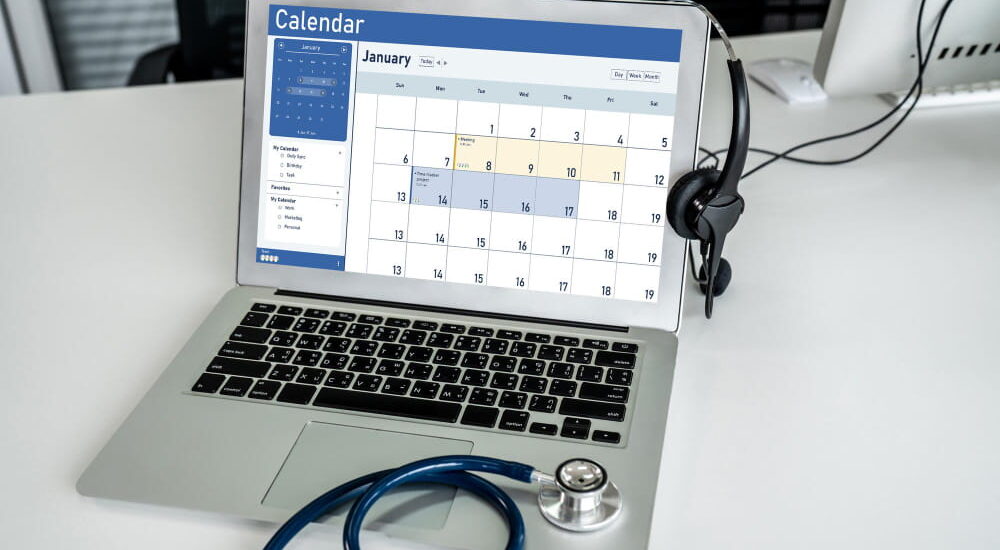
A full appointment calendar looks like a win for a clinic. It looks like a busy, productive, and financially healthy practice doing everything right. But full calendars hide problems that empty ones make obvious. A new patient consultation that ran for 40 minutes instead of 15 because nobody accounted for the complexity; the no-show at 10am that nobody rescheduled is still sitting there as a ghost slot; the front-desk spending the entire morning on phone calls that should have been handled the night before by an automated reminder. We bet it all sounds too familiar! According to the AMA, real appointments almost never fit the neat 15- or 30-minute blocks that most scheduling systems are built around. Some visits take five minutes. Others take more than 25. Late arrivals create ripple effects. No-shows waste a clinician’s time that can’t be recovered. And AHRQ data makes the patient side of this clear too — 43% of adults with urgent conditions reported they couldn’t get care as quickly as they needed, and 28% of women missed or had their care delayed because they couldn’t get a timely appointment. The reason for this is the in-house staff face several issues while tackling both administrative hassles and patient care. This is why taking the help of healthcare virtual assistant services makes sense. When they tackle all the patient management hassles, the in-house staff can stay free to focus on patient care. Scheduling isn’t just assigning a particular date and time. It’s the operational function that aligns the patient’s need with visit length, provider availability, follow-up timing, and care coordination — so the right patient reaches the right provider at the right moment with enough time to actually address what brought them in. CMS describes value-based care as care focused on quality, provider performance, and the overall patient experience. Under that framework, scheduling isn’t a side task handled by whoever picks up the phone. It’s a core component of how the patient experiences care from the moment they call till the moment they leave. AHRQ has also pointed to open-access and same-day scheduling models as effective tools for reducing wait-time delays. Hence, leaving room in the schedule for the unpredictable demand that actually shows up – rather than filling up every slot – is highly advisable. Done well; scheduling keeps clinical operations moving smoothly. Done poorly, it creates a compounding daily problem that nobody on staff has quite enough time to fully address. There are several problems clinics face, starting from no-shows to staff burnout due to ill-managed appointment scheduling. Not solving any one of these problems can make or break the clinic’s revenue cycle. A missed appointment is wasted time, wasted revenue, and wasted clinical opportunity that was reserved for a patient who never showed. AHRQ has documented that reminder and recall systems reduce missed appointments meaningfully. However, many clinics still rely on passive booking with no proactive outreach to patients who are prone to no-shows. CMS specifically advises clinics to track no-shows, cancellations without rescheduling, and referrals that never got booked. That level of tracking doesn’t happen when the front desk is already overwhelmed, managing the day in front of them. And in a care setting, HHS research has shown that no-show patterns can actually reduce providers’ willingness to accept referred patients which creates access barriers that compound well beyond any single missed appointment. This is why most clinics take the help of healthcare virtual assistant company in that matter. When a complex chronic disease management appointment and a routine prescription refill are treated as the same animal and given the same time slot — the day falls apart by mid-morning. Patients who showed up on time wait longer than they should have. Physicians often feel rushed when appointment lengths fail to reflect the complexity of patient needs. And the staff are left to absorb the frustration of everyone involved. AHRQ’s research on delayed care is direct on this point: patients notice when access is slow, and they don’t quietly accept it. They leave dissatisfied, which damages the practice’s reputation. And they sometimes just go elsewhere, which is the version of this story that hurts the most financially. Front desk and administrative staff are the people absorbing the consequences of scheduling problems most directly. Every no-show means a call to reschedule. Every double-booked slot means a difficult conversation with a patient who waits. Every missed prior authorization confirmation on a scheduled procedure means last-minute scrambling before the appointment. The AMA has documented that scheduling mismatches create measurable stress for both clinical and administrative staff. CMS’s value-based care framework reinforces that cleaner workflows protect the patient’s experience, and by extension, the practice’s financial performance. The tips for effective appointment scheduling include using patient reminders to matching the slot to the visit reason. These tips are highly important to streamline the claim submission procedure that every little step adds up to eventually. AHRQ recommends multi-channel reminder systems, which include phone, text, email, patient portal, even mail because patients respond differently to different communication formats. The research consistently shows that reminder systems reduce no-shows and increase the effective use of available appointment capacity. The AMA has reported cases where automated reminder systems cut no-show rates by 80%. That kind of result doesn’t require a large technology investment. Read More: The AMA recommends wave scheduling because it recognizes a reality every clinician understands: patient visits rarely fit neatly into predetermined time slots. Booking in waves means the schedule can absorb the natural variations in visit length without cascading delays that affect the entire afternoon. However, most clinics also take the help of outsourced healthcare virtual assistant services to create proper schedules. AHRQ’s support for same-day and open-access scheduling models speaks to the same underlying principle: leave room for the demand that can’t be predicted, rather than filling every slot weeks out and having no capacity when urgent needs arise. A follow-up visit for a stable patient on a stable medication regimen should not be allocated at the same time as a new patient appointment or a complex multi-problem visit. CMS’s emphasis on person-centered, coordinated care means scheduling has to be individualized to the patient’s actual needs; not standardized to whoever answers the phone fastest. Better intake triage, smarter categorization of visit types, and appointment lengths that actually reflect clinical complexity reduce rushed visits, improve documentation quality, and produce fewer billing problems downstream. A visit that was appropriately allocated enough time gets properly documented. A rushed visit often doesn’t. At some point, managing phones, reminders, reschedules, patient questions, and schedule optimization simultaneously exceeds what any in-house team can realistically handle well. The AMA has documented the administrative burden on clinical staff. In a healthcare market where access and efficiency directly affect patient outcomes and practice revenue, that’s not overhead. It’s an operational infrastructure. At SunKnowledge Services Inc., we provide a wide range of healthcare virtual assistant solutions that make managing your patients and running your facility a breeze. Our services – all delivered by skilled and experienced agents include: Our team can seamlessly integrate with provider calendars, operate on HIPAA-compliant scheduling platforms, and send pre-visit reminders as a standard part of the workflow. For practices struggling with no-show rates that won’t come down, a front-desk stretched beyond capacity, or a scheduling system that creates more problems than it solves — SunKnowledge brings the dedicated operational support that turns scheduling from a daily headache into a function that actually runs the way it should. Good scheduling isn’t just about filling slots. It’s about keeping the entire care workflow connected from the first booking call through the follow-up after the visit. Besides providing ready-to-outsource virtual assistants services at just $7 per hour, we have no restrictive clauses or binding contracts. Build your team, scale up (or down) according to your need, and get your practice running like a well-oiled machine. Connect with us and find out what proper scheduling and administrative support looks like with our expert healthcare virtual assistant services.Patient Appointment Scheduling: A Look under the Hood
Why Poor Appointment Scheduling Hurts Clinics
1) No-Shows and Empty Chairs
2) Longer Waits and Frustrated Patients
3) Staff Burnout and Revenue Leakage
Tips for Efficient Appointment Scheduling
1) Use Reminders that Actually Reach People
How Medical Virtual Office Assistance Can Change Your Clinics Efficiency
2) Build the Schedule around Real Visit Patterns
3) Match the Slot to the Reason for the Visit
Why Outsourced Virtual Assistant Services Makes Sense