
- October 15, 2026
- Posted by: Josh Knoll
- Categories: Radiology Billing, Virtual Assistants

U.S. radiology centers take care of administrative work, in addition to diagnostic imaging. They also coordinate appointments, obtain prior authorization, verify patients’ insurance coverage and follow up on all the insurance claims. When all these administrative hassles pile up, staff have less time to support patients and keep operations running smoothly. The radiology virtual assistant services help imaging clinics to manage all these responsibilities without adding every administrative task to their in-house team’s workload. These assistants help clinics maintain organized workflows and reduce claim delays. For all the independent imaging centers and diagnostic imaging facilities, proper support can strengthen the radiology billing process and improve the patient experience.
In this guide you will learn about:
- What Are Radiology Virtual Assistant Services?
- How Virtual Assistants Improve Radiology Billing
- Understanding Radiology Prior Authorization Requirements
- How Radiology Billing Services Manage Prior Authorization
- What to Look for in a Radiology Virtual Assistant Provider
- Should You Outsource Radiology Virtual Assistance?
- Why SunKnowledge is the Best Radiology Billing Company to Hire
- Frequently Asked Questions
What are Radiology Virtual Assistant Services?
Radiology assistants offer appropriate administrative assistance to imaging centers through remote assistance. They will help with the execution of the many responsibilities that fall under the umbrella of front office tasks and billing follow-up. A radiology management professional will be able to offer assistance from an administrative point of view in terms of imaging centers. It will involve scheduling for things like X-rays, MRIs, CT scans, and ultrasounds. This is how such help complements the existing staff to attend to patients only.
How Virtual Assistants Improve Radiology Billing
Efficient billing starts even before filing the claim. Simply put it begins with reviewing the patient’s information, insurance coverage, and so on in real time. Radiology virtual assistants help organize patient information and supporting documentation before claim submission. So, that is how billing professionals can tackle all the complex claim procedure.
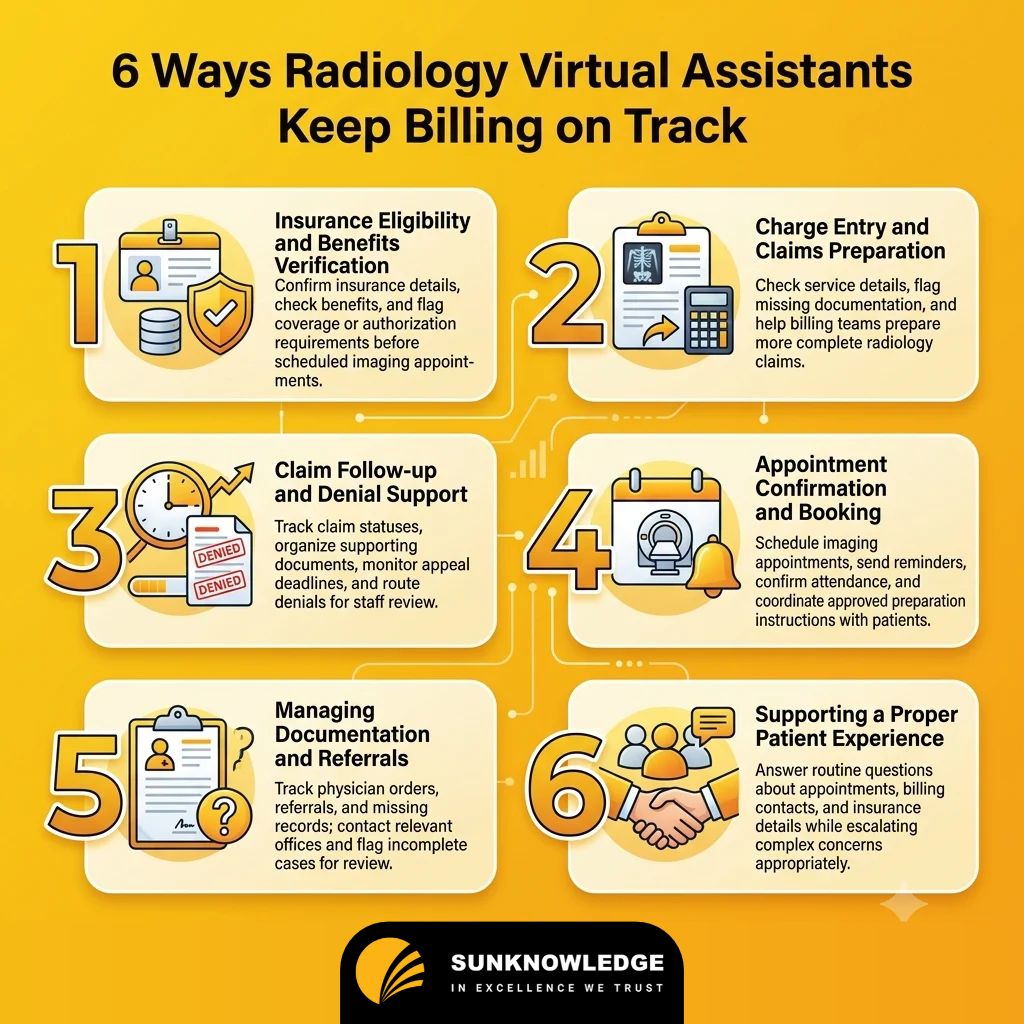
1) Insurance Eligibility and Benefits Verification
Outdated insurance information creates several issues during the claim submission procedure. Virtual assistants help confirm demographic details, plan information, and other needed registration data. They also support eligibility checks before scheduled imaging appointments. It helps staff identify coverage issues and determine whether authorization or a referral is required. Eligibility verification doesn’t guarantee payment. The clinics still need to follow the insurer’s coverage rules and confirm applicable coverage and documentation requirements.
2) Charge Entry and Claims Preparation
Diagnostic imaging billing needs accurate information about the services performed. Virtual assistants support administrative charge-entry workflows and route incomplete items to the right billing staff. For example, an imaging center can complete several MRI examinations in one single day. Moreover, they can also discover that some patient orders have missing documentation which the in-house staff at times miss. A virtual assistant can identify all the gaps and request missing documentation from the responsible team to get the needed information before the billing team proceeds. These checks properly support cleaner claim submission and consistent imaging claims management.
3) Claim Follow-up and Denial Support
Submitting a claim can be considered an important step of the radiology billing revenue cycle. Clinics need to track claim status, and coordinate responses to payer needs. A proper follow-up list, checking claim status, organizing the right documents and routing denials to experienced staff for review can be done by assistants. They can also track appeal deadlines and outstanding payer responses. This support properly strengthens the RCM process through reducing the likelihood of administrative follow-up tasks.
4) Appointment Confirmation and Booking
Virtual assistants can schedule appointments and coordinate referral information. They send appointment reminders, communicate approved instructions, confirm attendance, and help patients reschedule when needed. Staff may confirm specific preparation needs with the clinical teams before communicating the right instructions. These activities help reduce avoidable gaps and give front-desk staff more time to support patients who require assistance.
5) Managing Documentation and Referrals
Referral details, previous records, physician orders, or other supporting information may be needed in the case of imaging appointments. When all these items are missing, clinics may need to contact the referring provider before the claim submission procedure. Radiology billing outsourcing assistants track outstanding documents and contact the appropriate office, update administrative records and flag incomplete cases for review purposes. This organized approach helps staff to prepare for scheduled examinations.
6) Supporting a Proper Patient Experience
Appointment times, billing contacts, and insurance details are questions a patient can have. Timely responses make the imaging process easier to navigate. Assistants handle routine enquiries using the right communication procedure. Clinical advice, urgent concerns, and complicated financial disputes are the escalation that go to qualified staff.
Understanding the Prior Authorization Landscape
Federal requirements mostly change how certain health plans manage the prior authorization procedure. Under the CMS Interoperability and Prior Authorization Final Rule, covered payers will be required to issue PA requests within 72 hours in case of any urgency and seven calendar days for the standard requests. Starting from 2026, impacted payers need to give specific reasons for denied PA requests for all the covered medical items excluding drugs. This provision. These requirements apply only to the payer categories and requests covered by the rule. Follow-ups stay an important procedure even as insurer processes evolve for all the radiology clinics.
How Radiology Billing Services Manage Prior Authorization
There are several administrative hassles created by prior authorization mostly when plans need advance approval for certain diagnostic services. Staff need to identify applicable requirements, submit supporting information, follow up on the pending requests, and communicate the status updates. They also help to organize this whole process although the authorization decision remains with the payer.
1) Checking Authorization Needs before Imaging
Authorization needs vary by insurer, service, plan and clinical circumstances. A CT examination needs PA under one plan but follows different rules under another. This is why checking payer portals, reviewing practice-specific authorization guidance, and flagging examinations should be done by virtual assistants for imaging center. These medical assistants also help to verify that all the patient’s supporting documents are available before the submission procedure. The clinics need to confirm authorization needs with relevant payers rather than assuming one workflow applies to each and every patient.
2) Submitting Requests to Track Approvals
Once the request is properly ready, trained staff help to enter the information into the payer’s system attach the right documents, record reference numbers, and monitor all pending requests. In case the payer requires further information, the virtual assistants can alert the concerned department and also keep track of all pending requirements. As soon as the decision is made, the assistant maintains the clinical record and keeps the status updated through the authorized medium. This will help in maintaining proper insight into the pending authorization.
What to Look for in a Radiology Virtual Assistant Provider
Selecting a third party vendor entails proper assessment. This is the reason why one should always evaluate if the outsourcing vendor has knowledge of the processes and maintains patient privacy effectively. Proper arrangements should entail clear definition of roles of virtual assistants, billing department, and clinical teams.
1) Experience in Radiology Workflow
Always look for providers with experience supporting diagnostic imaging practices. Patient intake and eligibility verification are considered an important areas of support in this procedure.
2) HIPAA and Data Security
Remote access to all the patient information needs careful oversight of the HIPAA business associate. When applicable, a business associate agreement should be established by the clinics and verify that all the arrangements include protected health information. Moreover, access controls, approved communication channels, and procedures to report security incidents form part of the evaluation. A vendor’s general compliance assurance is not a substitute for checking contractual responsibilities and security practices.
3) Clear Accountability and Reporting
You need to ask how the clinics track assigned codes and escalate unresolved cases. Moreover, it is important to clarify who checks the work accuracy and makes decisions about coding and payer disputes. Reliable radiology billing services depend on measurable performance and transparent workflow, not simply the tasks completed.
Should You Outsource Radiology Virtual Assistance?
The right staffing model depends on the radiology clinic’s workload and existing expertise. Some clinics manage work internally while others benefit from external support during persistent backlogs. Radiology billing outsourcing is very helpful for the internal staff who can concentrate fully on patients and not have to bother about other things. Outsourcing can be chosen by the clinic in order to ensure that only the appropriate individuals manage the critical activities. The importance of outsourcing will depend on cost, integration, training, and performance. This is why always determine which tasks are needed, how data is sourced, and ways to measure performance.
Why SunKnowledge is the Best Radiology Billing Company to Hire
Radiology clinics require dependable administrative support to fit their existing operations. SunKnowledge provides radiology virtual office assistant services covering huge administrative and revenue cycle support activities for imaging clinics. Our experts stay updated with all the latest CPT, ICD, and HCPCS codes to reduce denials. Our service offering includes:
- Front-desk support
- Documentation
- Billing and coding assistance
- Prior authorization
- Customer support
- Data entry
1) Support for Billing and Administrative Hassles
We support clinics requiring additional capacity for routine billing-related tasks and documentation management. Practices can properly discuss all their additional needs including insurance verification, authorization tracking, and administrative support to determine the appropriate assistance scope. Moreover, you can get complete prior authorization support from us in which we verify the patient’s insurance eligibility, collect the right documents, and submit PA requests.
2) Flexible Support for Imaging Centers
Different clinics have different staffing requirements. An independent diagnostic imaging facility requires help with patient intake and authorization follow-ups. However, a larger radiology group requires support with documentation and administrative work spanning across several locations. Our virtual assistance model gives imaging centers an excellent option to explore additional operational capacity without assuming that each and every task will be handled by the onsite employees. This is why scope, system access, supervision, and service expectations need to be established before implementation.
3) A Practical Approach for Proper RCM Support
For clinics requiring trusted radiology billing solutions, the goal should be a workflow keeping administrative tasks visible, assigning clear responsibility, and supporting all the timely action. Virtual assistance can properly contribute to that particular goal when the work is thoroughly defined and integrated with the clinical billing teams. That is how we reduce the clinic’s operational costs by around 80%. We also provide a dedicated account manager and customized reports according to the client’s needs. SunKnowledge also provides the best infrastructure setup according to the client’s needs, and our experts have less than two days of turnaround time to tackle any issue.
Radiology virtual assistant services help US imaging centers coordinate billing support, insurance verification, and prior authorization efficiently. Clinics can improve their visibility across several workflows by assigning routine work to an experienced team like SunKnowledge. Hence, with our help, the experienced staff can get more time to address patient care needs and complex reimbursements. Always remember that the best result comes from choosing a clinic that understands radiology operations, measures performance against clinic’s goals and follows clear security procedures. With the right scope, virtual assistance becomes the practical part of the whole revenue cycle management process for imaging centers.
Want to streamline administrative hassles for your radiology billing? Contact SunKnowledge today to learn how we can help you.
Frequently Asked Questions:
What do radiology virtual assistants do?
Radiology virtual assistants support several administrative tasks including appointment scheduling, insurance eligibility checks, several billing-related administrative activities, and many more.
Can virtual assistants help reduce radiology billing delays?
They can help to organize claim status follow-ups, and route all the unresolved issues to the billing professionals. The results mostly depend on the workflow, supervision, training, and underlying delay cause.
Are radiology virtual assistant services HIPAA compliant?
Compliance depends on the clinic’s actual practices and contractual obligations. Radiology clinics need to assess the service arrangement, create a business associate agreement, and verify proper patient information protection.
Can a virtual assistant handle prior authorization for MRI and CT scans?
A trained assistant helps to check payer needs, track requests, record decisions and follow-up on all the missing information. The clinics can confirm the payer’s rules and make sure clinical decisions remain with the right person.