
- February 25, 2026
- Posted by: Josh Knoll
- Category: Sleep Study Billing

Sleep study billing is no longer just a regular back-office task. It is a high-risk operation dealing with evolving CMS reimbursement rules, stricter payer audits and growing demand for polysomnography services.
And having a comprehensive guide to sleep study billing and coding compliance that explains CPT codes, ICD-10 diagnosis alignment, modifier usage, documentation requirements and denial-prevention strategies comes as an advantage.
What Is a Sleep Study? Understanding Polysomnography and HSAT
A sleep study commonly known as a polysomnography (PSG) test is an overnight diagnostic procedure that evaluates sleep patterns and physiological activity and measures:
- Brain waves (EEG)
- Eye movements (EOG)
- Muscle tone (EMG)
- Heart rate (ECG)
- Respiratory effort and airflow
- Oxygen saturation
- Body position and limb movements
Sleep studies mainly diagnose conditions such as:
- Obstructive Sleep Apnea or OSA
- Central sleep apnea
- Narcolepsy
- Chronic insomnia
- REM sleep behavior disorder
From a billing standpoint, sleep testing falls into two main categories.
All about In-Lab vs. Home Sleep Study Billing in 2026
To order such clinical decision either for an in-lab sleep study or a home sleep apnea test one has to be equipped managing both its billing operation as the two are quite different. While the test operate under very different rules understanding the distinction here will only help achieve faster reimbursement, lower denial rates, and seamless sleep study billing services.
In-Lab Attended Polysomnography or PSG – An in-lab polysomnogram remains the diagnostic benchmark where a polysomnographic technologist monitors the patient overnight capturing multiple physiologic parameters in a controlled environment. In PSG the clinical intensity translates into higher reimbursement and also demands higher scrutiny equally.
Not to forget, the reimbursement for these services reflects staffing costs, facility overhead, and equipment use. And with 2026, CMS applies a 2.5 % efficiency adjustment to most non-time-based sleep testing codes, which affects projected revenue and must be factored into forecasting. While many sleep labs fall short of documentation requirements for better reimbursement, you need to ensure continuous technologist monitoring data and that a minimum of 6 hours of recorded data is submitted.
If the recording duration is less than 6 hours, the claim typically requires a -52 modifier to indicate reduced services and omitting can only trigger an immediate denial.
Because these services are performed in a controlled facility setting, the Place of Service (POS) code must reflect the correct environment. A mismatch between CPT and POS coding is one of the most common causes of automated rejections.
whereas for home sleep study billing or Home Sleep Apnea Testing (HSAT) it is an unattended, cost-effective alternative focused solely on obstructive sleep apnea (OSA). While the common codes include 95800, which records heart rate, oxygen, and sleep time and 95806 focuses on respiratory effort and airflow, HSAT yields lower reimbursement than in-lab tests . It at times does not even require prior authorization from private payers, though it is only covered for suspected OSA, not for complex comorbidities like COPD or CHF.
Related Reading: Optimizing Growth with a Trusted Sleep Study Billing Aide
Key Sleep Study CPT Codes for 2026
Correct CPT selection is the foundation of accurate sleep lab billing. Code selection depends on patient age, study type, and whether CPAP or BiPAP titration is performed.
In-Lab Sleep Study CPT Codes
- 95810 – Polysomnography; age 6 years or older, sleep staging with four or more additional parameters. This is the most commonly billed diagnostic sleep study code.
- 95811 – Polysomnography with CPAP or BiPAP titration. Used for split-night studies when PAP therapy begins during the same session.
- 95782 – Polysomnography; younger than 6 years old.
Pediatric sleep study billing requires careful documentation due to higher complexity.
Home Sleep Study CPT Codes
95800 – It is used when unattended home sleep study recording heart rate, oxygen saturation, and airflow is done.
95806 – This code ensures any unattended sleep study recording airflow, respiratory effort, and oxygen saturation.
Also, it is often seen payers often require home sleep apnea testing before approving in-lab studies, unless medical contraindications exist. Understanding payer-specific sleep study authorization requirements is thus quite essential here.
What is the Professional vs. Technical Component Billing in Sleep Medicine
One of the most common errors in sleep study billing and coding involves improper modifier usage.
- Modifier -26: Professional component (physician interpretation only)
- Modifier -TC: Technical component (equipment, facility, and technologist services)
If the same entity provides both services, global billing may apply. However, this depends on facility type and payer contract terms. Misuse of modifiers often results in partial payment or complete denial. Thus, when billing for a sleep study, HSAT etc always review payer guidelines for compliance with global sleep study billing.
Documentation Requirements for Sleep Study Reimbursement
Accurate coding alone is not enough in light of rising payer security, so your documentation must support every element of the claim.
- Face-to-Face Evaluation – A physician must perform and document a comprehensive clinical evaluation before ordering any of the sleep study. The record should include a detailed medical history, current medications and all the relevant comorbid conditions.
- Detailed Symptom Documentation – Vague statements is no longer accepted to establish medical necessity. Thys, if you are a sleep specialist, somnologist, or polysomnographic technologist document the frequency, severity and duration of symptoms such as snoring, daytime sleepiness, or even witnessed apneas.
- Prior Authorization for Sleep Studies – Many commercial payers require prior authorization before approving in-lab polysomnography. Thus, prior authorization for sleep study requests must include accurate CPT codes and supporting clinical documentation. Missing or expired authorization numbers often result in automatic claim denial.
- Interpretation Report – The interpreting physician must always provide a signed and dated diagnostic report where clear clinical impressions and the recommendations must be documented. A comprehensive interpretation supports both medical necessity and accurate claim adjudication along with:
- Total sleep time
- Apnea-Hypopnea Index or AHI
- Oxygen desaturation levels
- Treatment recommendations
Incomplete reports are common audit triggers.
2026 CMS Reimbursement Update: 2.5 % Efficiency Adjustment
This year CMS introduced a 2.5 % efficiency adjustment to most non-time based sleep testing codes, directly affecting reimbursement for in-lab diagnostic polysomnography and select HSAT services. While the percentage may appear modest for many the cumulative impact on high-volume sleep labs is quite significant here. And so practices must recalibrate revenue forecasts and closely monitor remittance trends. With tightening margins and rising operational costs, improving documentation accuracy, reducing denials, and optimizing workflow efficiency are key to successful sleep study billing services and financial stability.
Related Reading: Optimizing Growth with a Trusted Sleep Study Billing Aide
How to Improve Clean Claim Rates in Sleep Lab Billing
Top-performing sleep labs aim for a 97 % or higher first pass claim acceptance rate, like us, and for years, we have been excelling. Here’s how:
- Dedicated resources working on insurance verification for sleep studies
- Keeping a track of payer-specific denial trends
- Conduct internal coding audits monthly.
- Training staff on updated AASM and CMS guidelines
- Improve patient financial communication and ensure complete transparency to our sleep study clients.
CASE STUDY IN SLEEP CENTERS
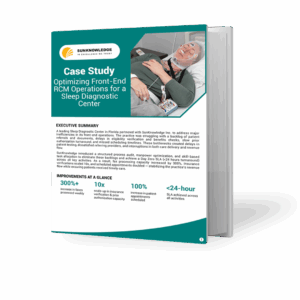
In fact, many sleep labs now outsource revenue cycle management for sleep studies and the reason is simple as outsourcing provides:
- Certified medical coders with sleep medicine expertise
- Dedicated prior authorization teams
- Denial management specialists
- Continuous payer policy monitoring
- Custom revenue performance reports
Specialized RCM support also reduces administrative burden and accelerates reimbursement.
The SunKnowledge Advantage in Sleep Study Billing Services
SunKnowledge offers end-to-end sleep study billing and coding services tailored to independent labs, hospital sleep centers, and multi-specialty practices.
Our team provides:
- 100% Prior authorization
- 99% charge entry accuracy services on the same day
- 80% operational cost reduction
- Aggressive denial follow-up
- Payer contract review and optimization
- Transparent reporting with dedicated account managers
We help sleep labs reduce operational costs while improving revenue realization with no binding long-term contracts. Sleep study billing compliance requires precision and between CMS reimbursement adjustments, payer scrutiny, and rising audit activity, we are here to help sleep labs operate disciplined revenue cycle processes.
If your current process is reactive, revenue is struggling, partner with us today and see what difference we can make in no time.